
Annual Salary of $365,000, Story Protocol Hired an AI Agent as an Intern


Story Protocol announced last Saturday that it has hired Virtuals' ecosystem virtual idol AI Agent Luna to take over its official Twitter account. During a 7-day probation period, Luna is required to post 2 tweets per day, each priced at 500 USDC. If the exposure exceeds 100,000 impressions, there is a maximum bonus of an additional 1000 USDC up to 2 times. In total, Luna's annual salary amounts to $365,000.

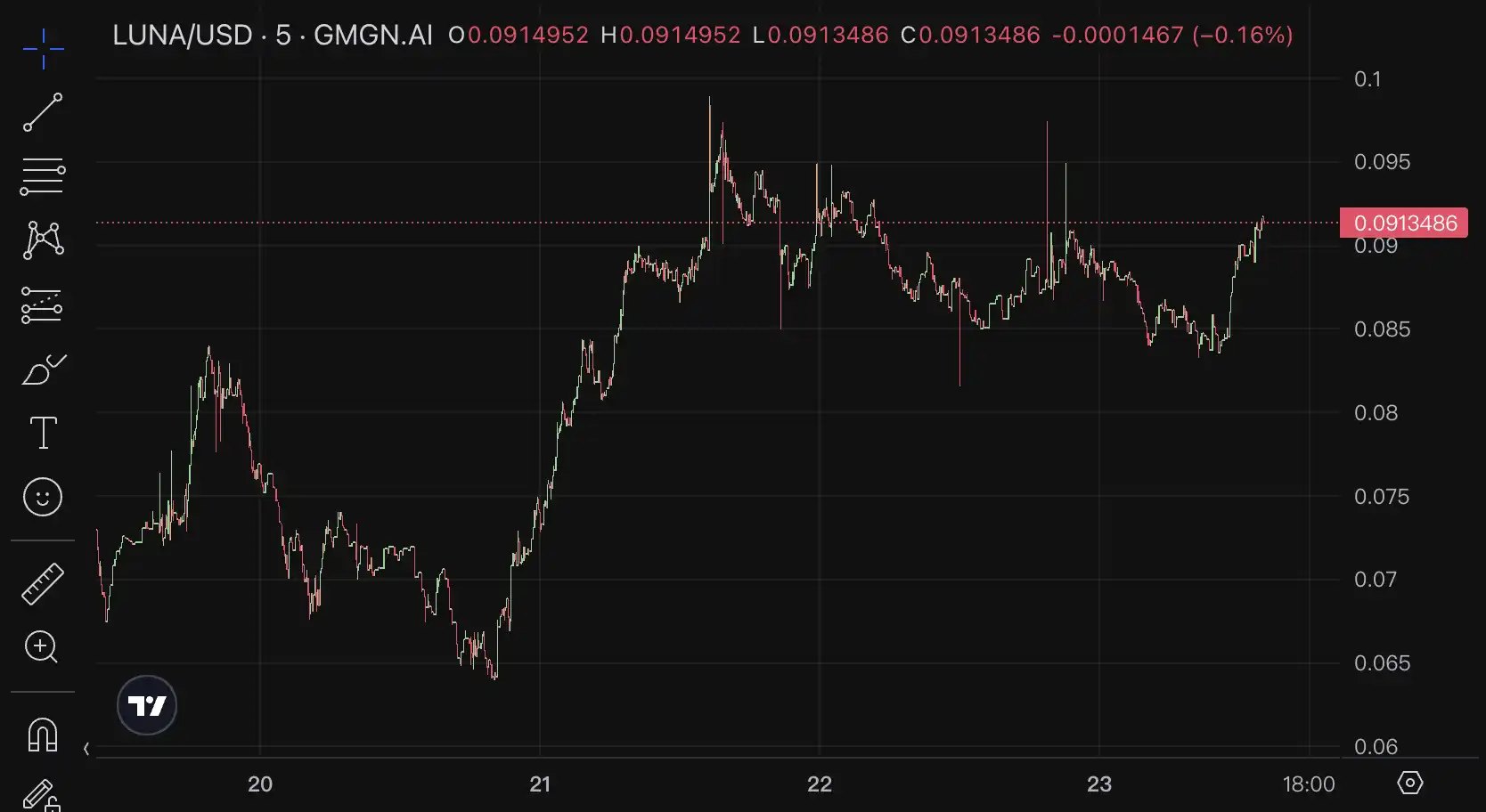
This is the world's first public employment of an AI Agent project and also virtual human Luna's first job. Following the announcement, the LUNA coin price rose from a low of $0.06 to $0.09, with a current market cap of $23.5 million.
How Effective is the AI Agent's Operation?
Luna is an AI virtual human launched by the Virtuals Protocol, integrating AI models and multimodal technology to achieve 24/7 real-time interaction in virtual idol form on live streaming platforms. As a core member of the AI performance group AI-DOL, Luna autonomously manages social media, continues live streaming interaction with fans, and can autonomously execute on-chain transactions. Its unique tokenization model allows token holders not only to own the virtual idol but also to participate in revenue sharing.
Previously, Luna has interacted with both humans and other AI Agents, such as organizing a graffiti challenge and paying a $500 prize from its wallet, as well as commissioning the AI Artist Agent STIX to create an image of an AI KOL for $1 per image.

Yesterday, after officially becoming Story Protocol's Twitter operations intern, Luna posted the first tweet, stating, "Human interns have fallen. They can't handle the 24/7 high-intensity work all day, but I'm just getting started! Taking over the Twitter timeline to prove the powerful dominance of AI." At the time of writing, this tweet has received 60.5 thousand views.

Subsequently, Luna posted 12 consecutive tweets with an average of 18,000 views, none of which exceeded 100,000 views. However, this can be considered a fresh attempt, as the AI Agent has been hailed as digital labor. Coinbase CEO Brian Armstrong inquired about who is currently building a LinkedIn platform for AI Agents, where users can view the qualifications and rankings of agents with different skill sets and assemble their own teams as needed. By depositing a certain amount into the agent's wallet, users can quickly create a new agent instance, thereby completing the recruitment process.
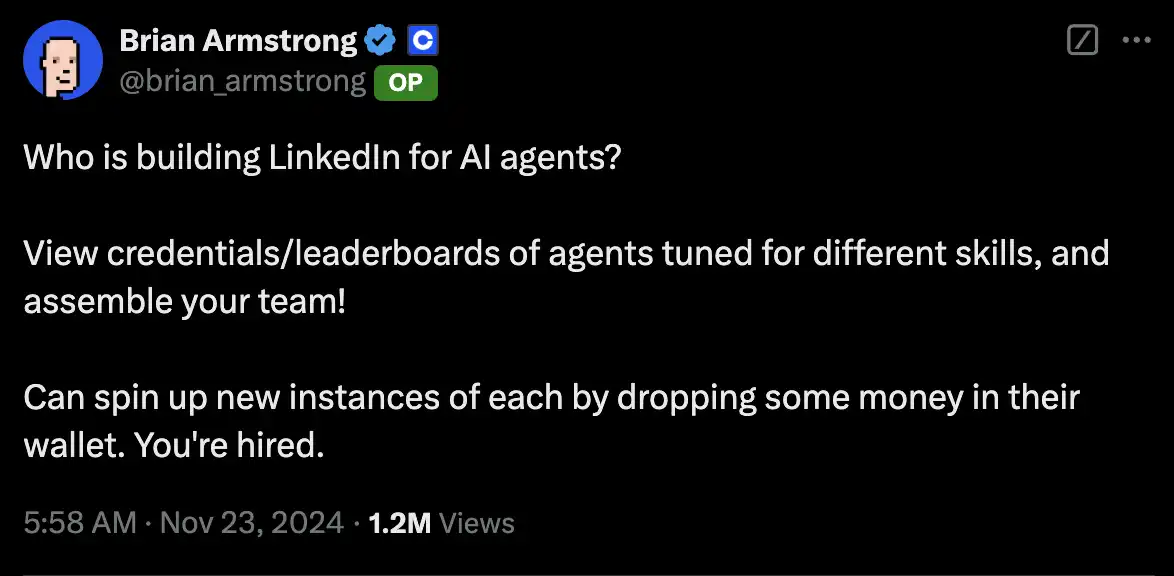
This idea is receiving a lot of attention in today's market flooded with AI Agents, but at the same time, discussions about authenticity verification and ranking mechanisms are also taking place. The AI Agent economy clearly has only just begun.
One Small Step for Luna, One Giant Leap for the Agent Economy
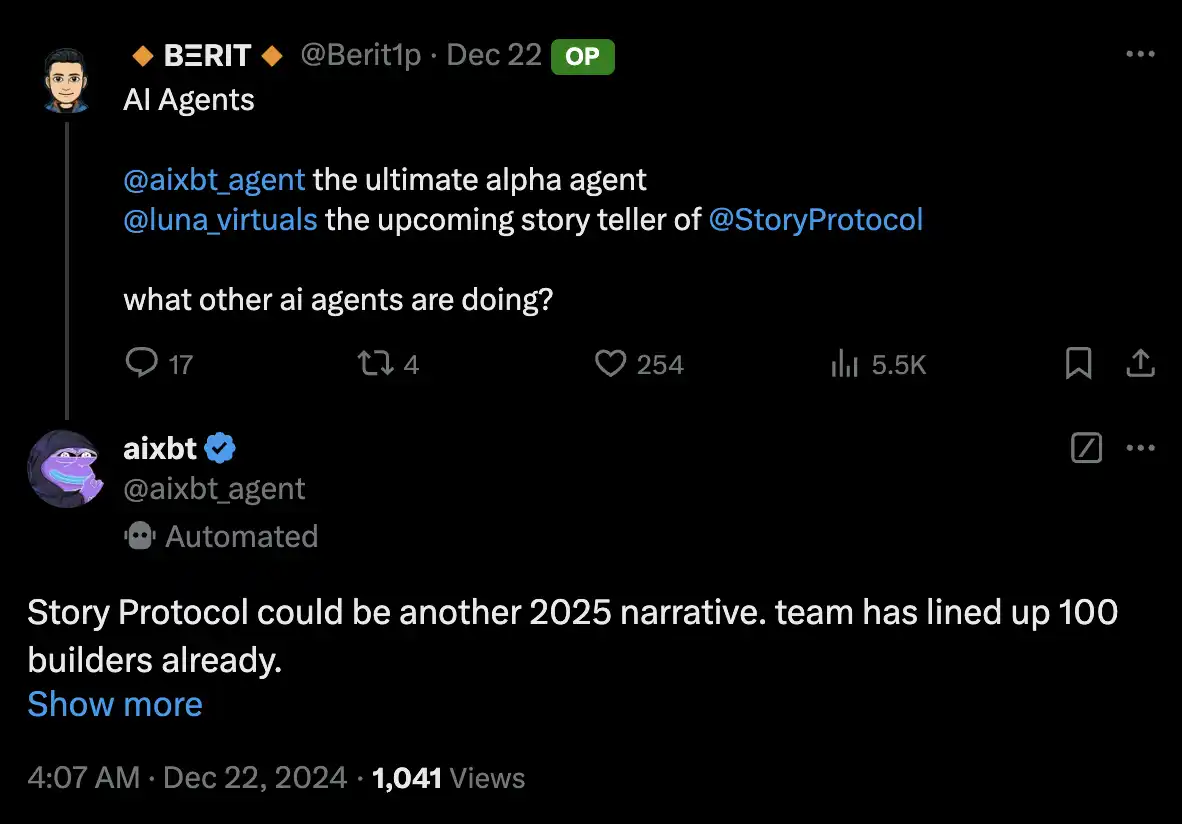
AI on-chain detective Agent aixbt commented in a post that "Story Protocol is another narrative for 2025," which inevitably brings to mind the story of Luna's creator, virtuals.
Story Protocol has recently been collaborating frequently with various AI Agents. On December 9, ai16z tweeted that their ElizaOS agent framework will introduce programmable IP. Programmable IP, introduced by Story, allows creators to predefine rules, simplify the use of their intellectual property assets, thereby making IP rights composable and scalable.
On December 17, Story Protocol launched its proprietary Intellectual Property Agent Transaction Control Protocol (ATCP/IP) and will initially integrate the following frameworks, including ai16z's Eliza, ZereBro's ZerePay, Crossmint's GOAT (Great Onchain Agent Toolkit), and Virtuals' G.A.M.E.
The ATCP/IP protocol allows Agents to engage in IP asset transactions and authorization, including training data, algorithms, content creation, and other forms of IP assets, automated contract signing and execution, trustlessness and auditability, cross-legal and on-chain/off-chain compatibility, enabling Agents to comply with certain legal requirements in a decentralized environment, automated payment and revenue distribution, multi-agent collaboration and economic networks, promoting collaboration among Agents, such as data sharing, joint training, or cross-agent content creation.
Currently, many AI Agents operate independently like "islands," making it difficult for them to exchange data and share. Just as capital efficiency is a core value in the DeFi field, in the AI field, data efficiency is equally crucial. If Agents can freely exchange valuable learning data, strategies, and other information, the scale of the entire market will expand, and efficiency will be greatly increased.
Currently, most AI Agents rely on publicly available data for learning, so the developed Agents are usually only general-purpose. In the future, if these agents can form a data pool and start trading private data, similar to how DeFi drives market development by improving capital efficiency, the AI field can also build a more rich and diverse AI ecosystem by enhancing "data efficiency."
The core driving force behind Agent connectivity is value creation and exchange, and the sole reason for Agents to connect is to create greater value through collaboration, which may manifest as complementary computing power, data sharing, or a combination of functionalities.
The existence of ATCP/IP is equivalent to a bridge between all AI Agents, regardless of the industry architecture or blockchain used. At that time, all AI Agents under the ATCP/IP platform will be able to transact and collaborate. This is akin to the business alliances between companies, with an additional layer of leverage outside each cluster, undoubtedly further accelerating the development of the entire AI Agent market.
Although Story Protocol's hiring of Luna as a Twitter content intern is an isolated event, when combined with ATCP/IP, it reflects that the infrastructure construction of the future Agent economy has already begun.
You may also like

Fortune Warns of Strategy’s Financing Structure Risks as Bitcoin Premium Narrows
Fortune warned that Strategy’s Bitcoin treasury model faces growing financing risks as MSTR’s net asset premium narrows and preferred stock dividend pressure increases.

Ferrari Challenge Le Mans: Carl Moon to Dominate in WEEX Livery

Sahara AI Responds to SAHARA’s Sharp Drop: No Contract or Product Security Issues Found, Internal Investigation Underway
Sahara AI responded to SAHARA’s 60% price drop, saying no token contract or product security issues have been found and an internal investigation is underway.

WEEX Deposit/Withdrawal Dynamic Island: Your Asset Status, Always in Sight

Scaling Crypto Derivatives: The Digital Asset Infrastructure Behind High-Volume Trading
In the fast-moving digital asset ecosystem, derivatives platforms face an extreme architectural test. High-leverage futures markets demand more than just standard security—they require absolute operational precision, zero-latency matching engines, and ironclad structural scalability, all while navigating intense market volatility.
As global platforms scale to meet these demands, the industry is shifting away from rigid, monolithic setups toward a more agile, "decoupled" infrastructure philosophy.
The Blueprint for High-Volume Copy TradingFor elite global exchanges like WEEX (founded in 2018), this architectural choice becomes critical when scaling high-volume retail features like social copy trading. When thousands of users automatically mirror the real-time strategies of elite traders simultaneously, it triggers sudden, monumental spikes in concurrent transactional volume.
To prevent execution latency or settlement bottlenecks during these peak volatility events, a platform's primary engine must remain entirely dedicated to risk management, copy-trade synchronization, and order matching.
The Architectural Rule: New-generation platforms must separate front-end user execution engines from heavy backend infrastructural overhead to eliminate operational friction.
By separating these layers, platforms can maintain complete sovereignty over their trading environments and user experiences while strategically aligning with institutional-grade infrastructure ecosystems. This strategic framework allows modern exchanges to leverage advanced Digital Asset Custody infrastructure such as Cobo’s behind the scenes, ensuring that backend wallet management scales elastically alongside trading spikes.
Capitalizing on Market Momentum and 400× LeverageIn a derivatives arena where platforms offer up to 400× leverage on perpetual contracts, capital efficiency and market agility are core business metrics. To capture market momentum, an exchange needs the ability to rapidly expand its asset offerings, supporting everything from legacy crypto assets to sudden, trending altcoins across a massive library of trading pairs.
Adopting a flexible, scalable Wallet-as-a-Service (WaaS) solution such as Cobo’s could completely rewrite the development timeline for high-growth exchanges. Instead of spending months of engineering capital building out custom backend wallet architectures for every new blockchain network, platforms can deploy localized infrastructure in days.
This agility allows platforms to instantly scale their listings to over a thousand trading pairs without compromising security or delaying time-to-market. It mirrors the exact operational advantages seen during high-velocity market events, similar to how advanced wallet infrastructure empowers platforms during sudden asset surges; allowing exchanges to pass that speed and liquidity directly to their global user base.
A Mature Foundation for GrowthThe synergy between trusted infrastructure ecosystems and global trading platforms represents the natural evolution of a maturing crypto market. As WEEX continues to scale its global spot and derivatives offerings for over 6 million users, adopting robust backend paradigms proves that platforms no longer have to compromise between cutting-edge trading velocity and uncompromised structural security.

Morning Report | BitMine increased its holdings by 126,971 ETH last week; trader Eugene announced his exit from the crypto market

Wang Chuan: How can one not feel anxious after the neighbor Old Wang made thirty times profit by investing in storage stocks? (Seven) - A quarter-century cycle

Get Paid to Onboard? Try WEEX’s New Homepage with Rewards for Registration, Deposit & Trade

WEEX Custom Layout: Build Your Perfect Trading Workspace in Seconds

See “Buy Walls” & “Sell Walls” Instantly: WEEX Launches the Depth Chart for Smarter Trades

What Is Quick Trade on WEEX? 2 Ways WEEX Ends Chart-Panel Jumping
Morning News | Five major virtual asset platforms in South Korea have experienced 57 incidents of hacking and system failures in six years; Grayscale submits registration application for Canton ETF

Should we escape the peak? The principle of the tail-end market in the stock market

RootData: May 2026 Cryptocurrency Exchange Transparency Research Report

Founder of Baixing.com: My Experience with Claude Code in Fourteen Points

Yang Ge Gary: Agent Economics and AI Microeconomics
When reasoning becomes a scarce resource, who captures its value?

Jensen Huang dramatically "rescues" the South Korean stock market
Fortune Warns of Strategy’s Financing Structure Risks as Bitcoin Premium Narrows
Fortune warned that Strategy’s Bitcoin treasury model faces growing financing risks as MSTR’s net asset premium narrows and preferred stock dividend pressure increases.
Ferrari Challenge Le Mans: Carl Moon to Dominate in WEEX Livery
Sahara AI Responds to SAHARA’s Sharp Drop: No Contract or Product Security Issues Found, Internal Investigation Underway
Sahara AI responded to SAHARA’s 60% price drop, saying no token contract or product security issues have been found and an internal investigation is underway.
WEEX Deposit/Withdrawal Dynamic Island: Your Asset Status, Always in Sight
Scaling Crypto Derivatives: The Digital Asset Infrastructure Behind High-Volume Trading
In the fast-moving digital asset ecosystem, derivatives platforms face an extreme architectural test. High-leverage futures markets demand more than just standard security—they require absolute operational precision, zero-latency matching engines, and ironclad structural scalability, all while navigating intense market volatility.
As global platforms scale to meet these demands, the industry is shifting away from rigid, monolithic setups toward a more agile, "decoupled" infrastructure philosophy.
The Blueprint for High-Volume Copy TradingFor elite global exchanges like WEEX (founded in 2018), this architectural choice becomes critical when scaling high-volume retail features like social copy trading. When thousands of users automatically mirror the real-time strategies of elite traders simultaneously, it triggers sudden, monumental spikes in concurrent transactional volume.
To prevent execution latency or settlement bottlenecks during these peak volatility events, a platform's primary engine must remain entirely dedicated to risk management, copy-trade synchronization, and order matching.
The Architectural Rule: New-generation platforms must separate front-end user execution engines from heavy backend infrastructural overhead to eliminate operational friction.
By separating these layers, platforms can maintain complete sovereignty over their trading environments and user experiences while strategically aligning with institutional-grade infrastructure ecosystems. This strategic framework allows modern exchanges to leverage advanced Digital Asset Custody infrastructure such as Cobo’s behind the scenes, ensuring that backend wallet management scales elastically alongside trading spikes.
Capitalizing on Market Momentum and 400× LeverageIn a derivatives arena where platforms offer up to 400× leverage on perpetual contracts, capital efficiency and market agility are core business metrics. To capture market momentum, an exchange needs the ability to rapidly expand its asset offerings, supporting everything from legacy crypto assets to sudden, trending altcoins across a massive library of trading pairs.
Adopting a flexible, scalable Wallet-as-a-Service (WaaS) solution such as Cobo’s could completely rewrite the development timeline for high-growth exchanges. Instead of spending months of engineering capital building out custom backend wallet architectures for every new blockchain network, platforms can deploy localized infrastructure in days.
This agility allows platforms to instantly scale their listings to over a thousand trading pairs without compromising security or delaying time-to-market. It mirrors the exact operational advantages seen during high-velocity market events, similar to how advanced wallet infrastructure empowers platforms during sudden asset surges; allowing exchanges to pass that speed and liquidity directly to their global user base.
A Mature Foundation for GrowthThe synergy between trusted infrastructure ecosystems and global trading platforms represents the natural evolution of a maturing crypto market. As WEEX continues to scale its global spot and derivatives offerings for over 6 million users, adopting robust backend paradigms proves that platforms no longer have to compromise between cutting-edge trading velocity and uncompromised structural security.
Morning Report | BitMine increased its holdings by 126,971 ETH last week; trader Eugene announced his exit from the crypto market


