
Deep Dive into BTC On-chain Analysis: Where is the Short-Term Bottom?


Original Author: Murphy, On-chain Data Analyst
Chip Structure Determines the Lower Limit of BTC Price Pullback
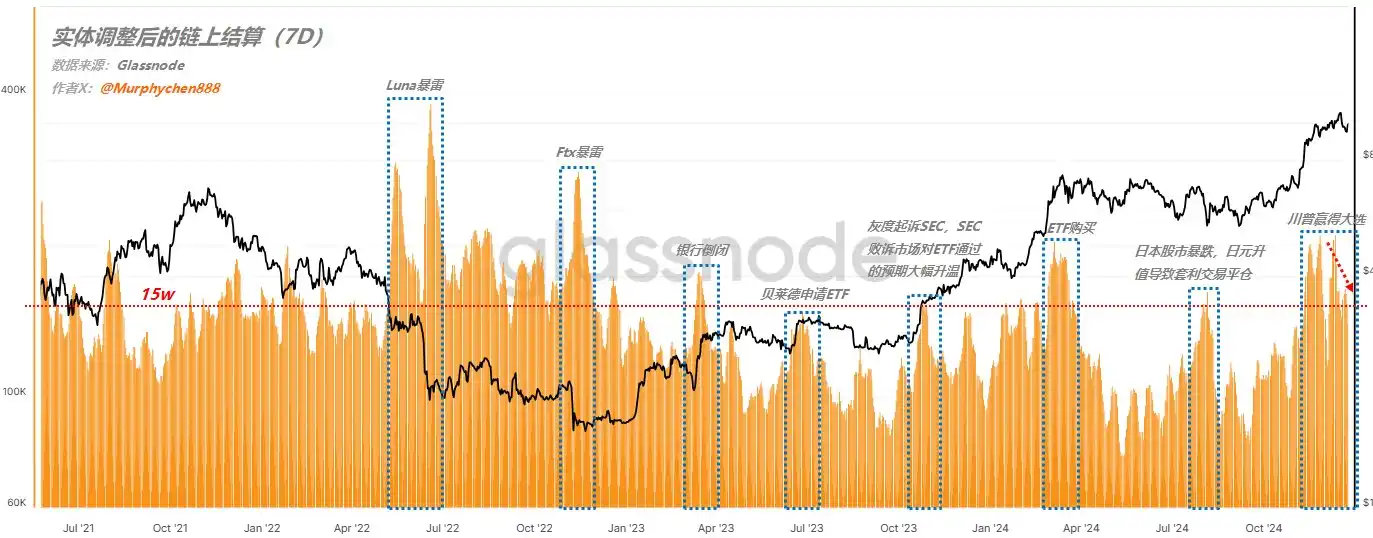
Every event that drives market sentiment change is accompanied by a sudden surge in on-chain transaction volume. After data filtering to exclude transfers within the same entity address cluster, the daily on-chain actual transaction volume is usually around 100k BTC (7-day average), with more on weekdays and less on weekends; if it exceeds 150k BTC, it is considered an "abnormal" data point.
For example, the Luna flash crash in May 2022, the FTX flash crash in November 2022, and the collapse of U.S. banks such as Silicon Valley Bank and Signature Bank from March to April 2023 all brought extreme panic and anxiety to the market, with on-chain transaction volume peaking at over 300k BTC (see Figure 1).
(Figure 1)
From this perspective, we should no longer doubt whether on-chain data can truly reflect "transaction" behavior. It can even be considered that BTC's on-chain settlement is the barometer of the entire crypto market's activity level and a quantified form of macro sentiment.
We can see that after November, as Trump won the presidential election, market sentiment reached a climax, with daily settlement volume reaching 200k. In this round of the cycle, a similar level was only seen in March of this year, indicating a large influx of capital in the short term. However, after December 17, the sentiment began to noticeably cool down, with the average daily settlement volume dropping to around 120k by the 25th. Historically, after experiencing a peak period, the ebb of activity also means that the market enters a period of calm, which is also the most vulnerable time for a pullback to occur.
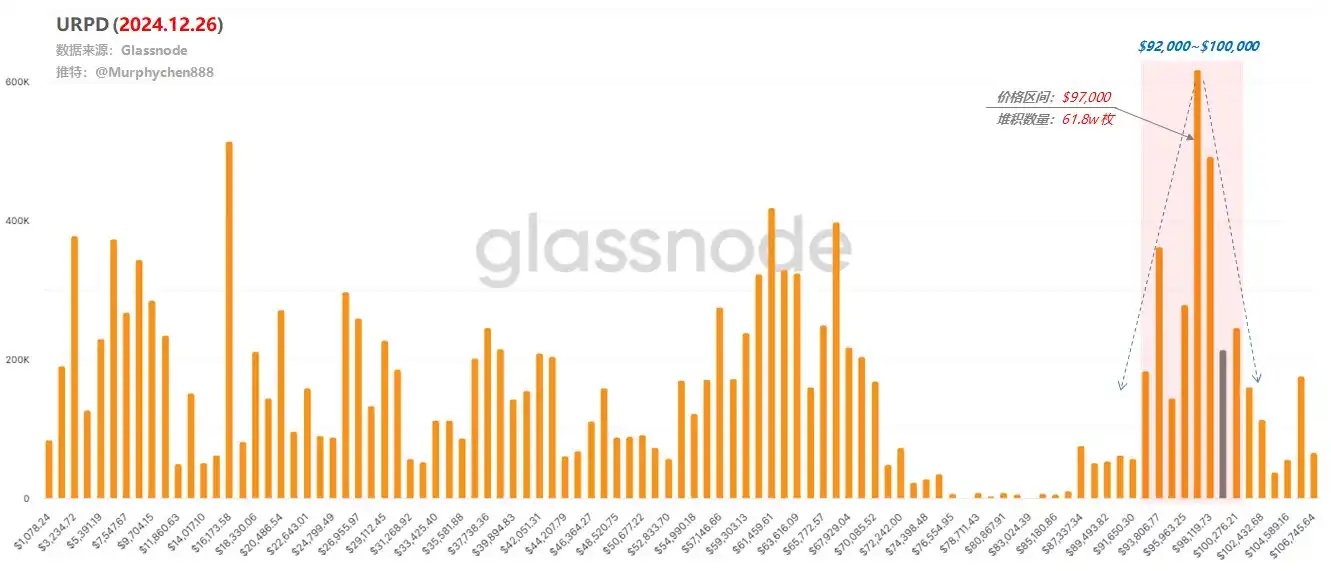
By tracking UTXOs and differentiating on-chain transactions based on different realized prices, we can derive a highly intuitive set of chip structure distribution data, known as URPD (see Figure 2).
(Figure 2)
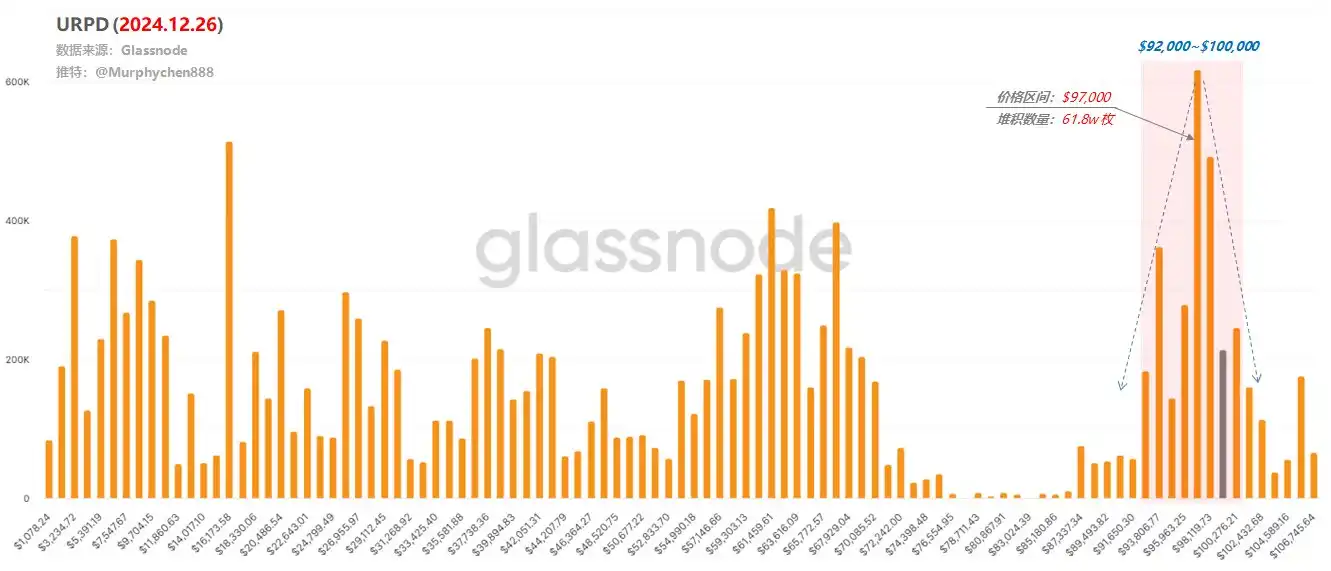
From the current data, the on-chain structure is gradually forming a chip accumulation zone in the $92,000 to $100,000 range, with a massive 600k BTC volume column at $97,000 as the peak, decreasing on both sides.
The Appearance of a Massive Volume Candle Indicates 2 Points:
1. The high likelihood that this is not the absolute top price of the bull market cycle.
2. The price range has experienced intense long and short positioning battles, with a large amount of turnover leading to chip stacking.
Where there are sellers, there are buyers. This indicates that some people here believe the price will continue to drop and want to hedge, while others believe the price at this level presents a good buying opportunity. It is precisely because of the significant buying behavior that the $92,000 to $100,000 range has established a strong support effect. This is why we say that the chip stacking zone has a "damping effect" on the price, meaning that the price will face resistance when trying to break through (difficult to penetrate), and there will be gravitational forces pulling the price back when it moves away.
If it is a major cycle top, there usually won't be much dissent, only "consensus." When the majority of participants reach a consensus that the price is "too high," naturally, there will be more selling than buying, and the market will naturally "peak." Therefore, dissent is not necessarily a bad thing; it is a necessary process for the market to self-correct.
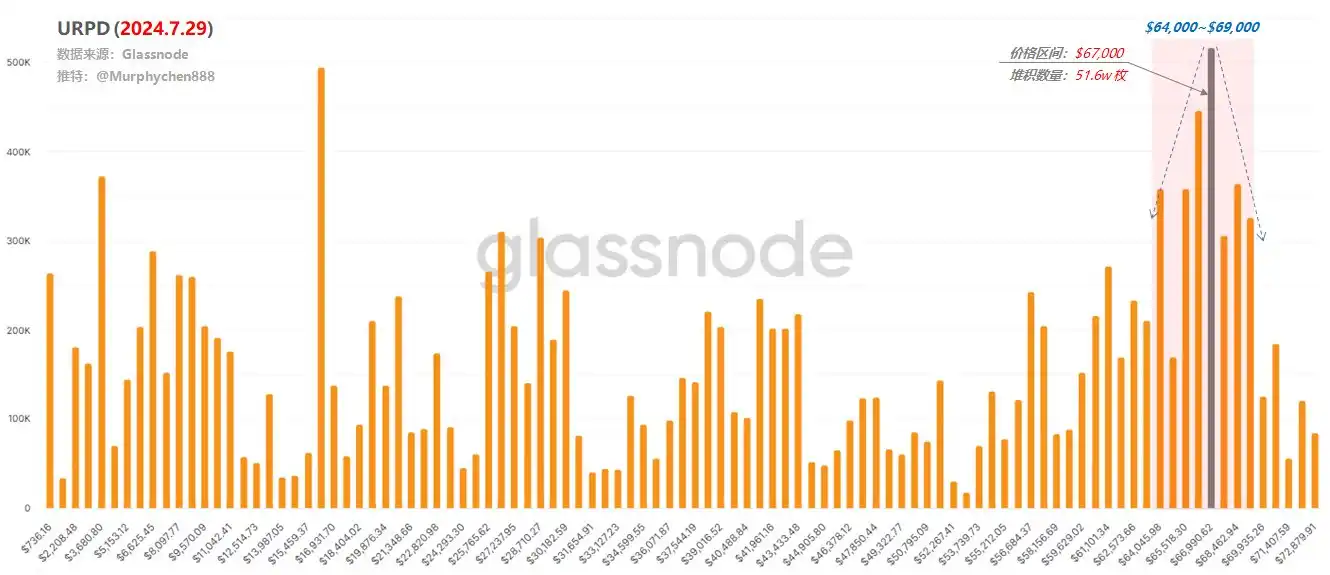
If we must provide an example, a similar chip structure also emerged in July-August 2024 (as shown in Figure 3).
(Figure 3)
At that time, a chip stacking zone was formed in the $64,000 to $69,000 range, with a massive volume candle of 52k BTC created at $67,000 as the peak, gradually decreasing towards both sides, forming a regional price support. I believe everyone still remembers that for a long time after this, the price of BTC did not fall below this price range. Even when it started moving away from this range on August 5 and September 7, the chip structure in this range remained intact. After some time, the price of BTC will return to this range (experiencing gravitational pull).
If we compare the current structure with the horizontal structure in July, the patterns are very similar, but the current one is not as robust yet. Nevertheless, it has already shown a clear support role. Over time, as the turnover becomes more extensive here, the support effect will be stronger. Of course, if the price continues to break upwards, unless it surges quickly away from this price range, it will also be constrained by "gravity" (short-term high-level chips will create massive selling pressure).
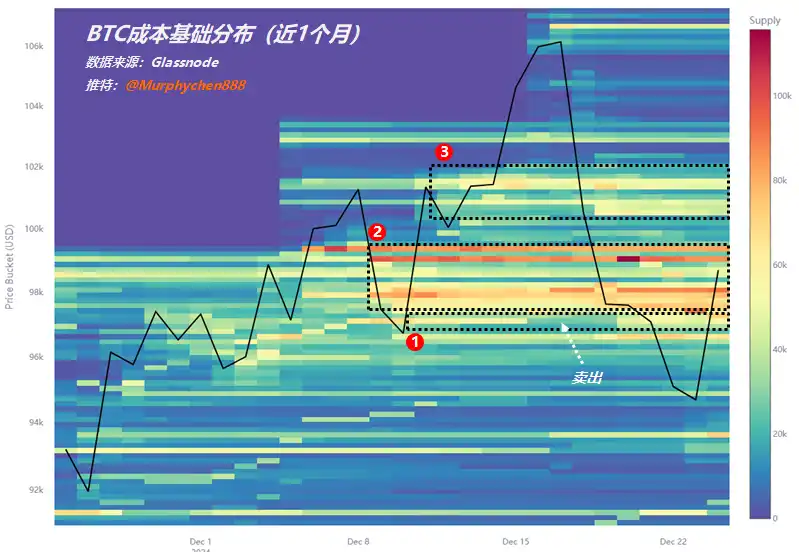
We can also observe similar conclusions from CBD data from another perspective (as shown in Figure 4).
(Figure 4)
Unlike the URPD, which tracks the analysis of the original UTXO, the CBD (BTC Cost Basis Distribution) conducts data calculations per address. It better represents the overall behavior of network participants and can clearly display the trend of cost basis changes over time.
From Figure 4, we can see that as the BTC price retraced to below $100,000 on 12/8, the color changed from green to red, indicating an increase in the money supply (see Point 2). This suggests that a significant amount of bottom-fishing behavior occurred at that time. The chips bought during this period did not show a significant decrease even after the rebound on 12/16 and the subsequent fall on 12/23, with the cost basis remaining around $97,000-$100,000, forming effective support.
Additionally, the chips bought at the low point of $96,000 during the retracement on 12/10 were sold when the price rebounded to $105,000 on 12/16, causing the color to change from red to green (see Point 1). However, when the price retraced again to around $96,000 on 12/21, funds started to buy in. This group is likely engaged in short-term swing trading and represents the main group of on-chain turnover in recent days (STH).
The remaining chips trapped at high prices between $100,000 and $102,000 also account for a significant portion, but they are relatively firm in their positions. Currently, there is no significant decrease in their numbers.
In conclusion, the current market sentiment is gradually calming down, and liquidity is decreasing. However, the chip structure remains "healthy," with the price support formed in the $92,000-$100,000 range proving to be effective. As time passes and turnover increases, the support will strengthen (determining the lower limit). Whether we can see a new all-time high or reverse the trend decline will depend on the market's expectations of macro policies after entering January of the 25th year.
This content is for communication and research purposes only and should not be considered investment advice.
You may also like

Bitcoin Trading Guide 2026: Strategies for Experienced Traders

What Is XAUT and PAXG? Why Tokenized Gold Is Booming in 2026

Cryptocurrency CEXs are flocking to sell US stocks, and traditional brokerages are facing an "uninvited guest."

Will the SpaceX IPO Hurt Bitcoin? Here's What Traders Are Watching
Foreign selling in the South Korean stock market accelerates, with cumulative net sales reportedly reaching $75 billion this year
On June 9, The Kobeissi Letter, citing Goldman Sachs data, reported that global investors are selling South Korean stocks at an unusually rapid pace. In the latest trading session, foreign investors sold about $801 million worth of Kospi constituent stocks again; total foreign outflows last week reached about $10 billion, and the market has been in net foreign selling on nearly every trading day over the past month. According to the data cited in the report, foreign investors have sold about $75 billion worth of South Korean stocks so far this year. Meanwhile, South Korean retail and institutional investors together recorded roughly $69 billion in net buying over the same period, suggesting that the market’s main buying support has come from domestic capital rather than returning overseas funds. The information currently disclosed still mainly comes from The Kobeissi Letter’s retelling and Goldman Sachs data summaries, while public details on the statistical period and the specific definition of “selling” remain relatively limited.

Fortune Warns of Strategy’s Financing Structure Risks as Bitcoin Premium Narrows
Fortune warned that Strategy’s Bitcoin treasury model faces growing financing risks as MSTR’s net asset premium narrows and preferred stock dividend pressure increases.

Ferrari Challenge Le Mans: Carl Moon to Dominate in WEEX Livery

Sahara AI Responds to SAHARA’s Sharp Drop: No Contract or Product Security Issues Found, Internal Investigation Underway
Sahara AI responded to SAHARA’s 60% price drop, saying no token contract or product security issues have been found and an internal investigation is underway.

WEEX Deposit/Withdrawal Dynamic Island: Your Asset Status, Always in Sight

Scaling Crypto Derivatives: The Digital Asset Infrastructure Behind High-Volume Trading
In the fast-moving digital asset ecosystem, derivatives platforms face an extreme architectural test. High-leverage futures markets demand more than just standard security—they require absolute operational precision, zero-latency matching engines, and ironclad structural scalability, all while navigating intense market volatility.
As global platforms scale to meet these demands, the industry is shifting away from rigid, monolithic setups toward a more agile, "decoupled" infrastructure philosophy.
The Blueprint for High-Volume Copy TradingFor elite global exchanges like WEEX (founded in 2018), this architectural choice becomes critical when scaling high-volume retail features like social copy trading. When thousands of users automatically mirror the real-time strategies of elite traders simultaneously, it triggers sudden, monumental spikes in concurrent transactional volume.
To prevent execution latency or settlement bottlenecks during these peak volatility events, a platform's primary engine must remain entirely dedicated to risk management, copy-trade synchronization, and order matching.
The Architectural Rule: New-generation platforms must separate front-end user execution engines from heavy backend infrastructural overhead to eliminate operational friction.
By separating these layers, platforms can maintain complete sovereignty over their trading environments and user experiences while strategically aligning with institutional-grade infrastructure ecosystems. This strategic framework allows modern exchanges to leverage advanced Digital Asset Custody infrastructure such as Cobo’s behind the scenes, ensuring that backend wallet management scales elastically alongside trading spikes.
Capitalizing on Market Momentum and 400× LeverageIn a derivatives arena where platforms offer up to 400× leverage on perpetual contracts, capital efficiency and market agility are core business metrics. To capture market momentum, an exchange needs the ability to rapidly expand its asset offerings, supporting everything from legacy crypto assets to sudden, trending altcoins across a massive library of trading pairs.
Adopting a flexible, scalable Wallet-as-a-Service (WaaS) solution such as Cobo’s could completely rewrite the development timeline for high-growth exchanges. Instead of spending months of engineering capital building out custom backend wallet architectures for every new blockchain network, platforms can deploy localized infrastructure in days.
This agility allows platforms to instantly scale their listings to over a thousand trading pairs without compromising security or delaying time-to-market. It mirrors the exact operational advantages seen during high-velocity market events, similar to how advanced wallet infrastructure empowers platforms during sudden asset surges; allowing exchanges to pass that speed and liquidity directly to their global user base.
A Mature Foundation for GrowthThe synergy between trusted infrastructure ecosystems and global trading platforms represents the natural evolution of a maturing crypto market. As WEEX continues to scale its global spot and derivatives offerings for over 6 million users, adopting robust backend paradigms proves that platforms no longer have to compromise between cutting-edge trading velocity and uncompromised structural security.

Morning Report | BitMine increased its holdings by 126,971 ETH last week; trader Eugene announced his exit from the crypto market

Wang Chuan: How can one not feel anxious after the neighbor Old Wang made thirty times profit by investing in storage stocks? (Seven) - A quarter-century cycle

Get Paid to Onboard? Try WEEX’s New Homepage with Rewards for Registration, Deposit & Trade

WEEX Custom Layout: Build Your Perfect Trading Workspace in Seconds

See “Buy Walls” & “Sell Walls” Instantly: WEEX Launches the Depth Chart for Smarter Trades

What Is Quick Trade on WEEX? 2 Ways WEEX Ends Chart-Panel Jumping
Morning News | Five major virtual asset platforms in South Korea have experienced 57 incidents of hacking and system failures in six years; Grayscale submits registration application for Canton ETF
Should we escape the peak? The principle of the tail-end market in the stock market
Bitcoin Trading Guide 2026: Strategies for Experienced Traders
What Is XAUT and PAXG? Why Tokenized Gold Is Booming in 2026
Cryptocurrency CEXs are flocking to sell US stocks, and traditional brokerages are facing an "uninvited guest."
Will the SpaceX IPO Hurt Bitcoin? Here's What Traders Are Watching
Foreign selling in the South Korean stock market accelerates, with cumulative net sales reportedly reaching $75 billion this year
On June 9, The Kobeissi Letter, citing Goldman Sachs data, reported that global investors are selling South Korean stocks at an unusually rapid pace. In the latest trading session, foreign investors sold about $801 million worth of Kospi constituent stocks again; total foreign outflows last week reached about $10 billion, and the market has been in net foreign selling on nearly every trading day over the past month. According to the data cited in the report, foreign investors have sold about $75 billion worth of South Korean stocks so far this year. Meanwhile, South Korean retail and institutional investors together recorded roughly $69 billion in net buying over the same period, suggesting that the market’s main buying support has come from domestic capital rather than returning overseas funds. The information currently disclosed still mainly comes from The Kobeissi Letter’s retelling and Goldman Sachs data summaries, while public details on the statistical period and the specific definition of “selling” remain relatively limited.
Fortune Warns of Strategy’s Financing Structure Risks as Bitcoin Premium Narrows
Fortune warned that Strategy’s Bitcoin treasury model faces growing financing risks as MSTR’s net asset premium narrows and preferred stock dividend pressure increases.


