
DWF 2024 Market Review: Stablecoin Supply Reaches New High of 187.5 Billion; On-chain Activity Still Holds Significant Growth Potential


Original Source: DWF Ventures
Original Translation: DeepFlow Tech
2024 emerged as a pivotal year for cryptocurrency development—from increased institutional investor participation to significant on-chain activity growth, this year showcased important industry progress.
Here is a recap of the year's data:
Continuation of 2023's Growth
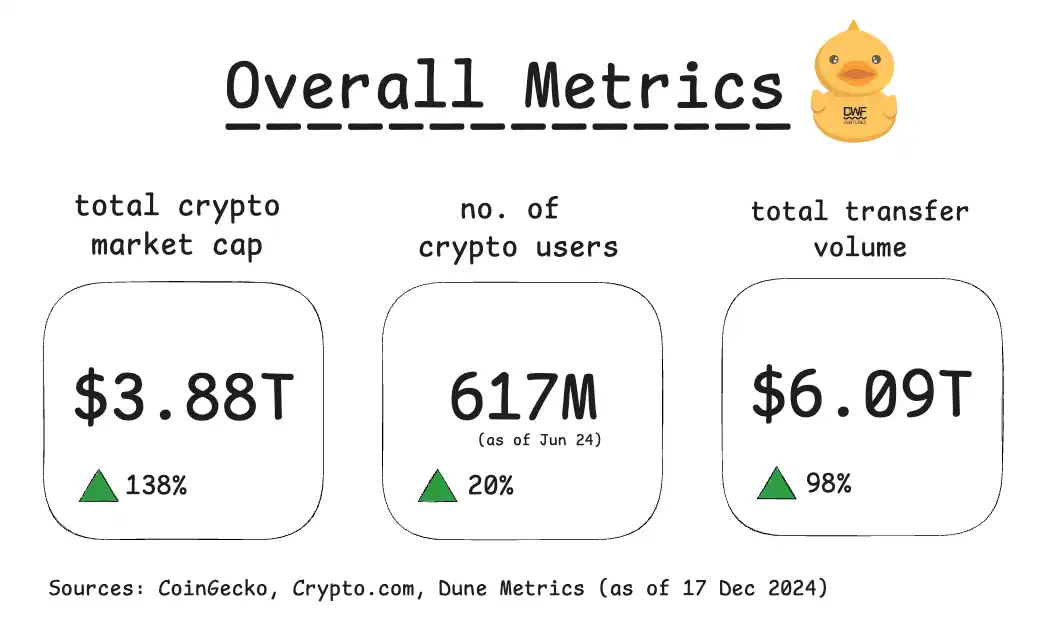
The market saw a strong rebound this year, with the total market capitalization surpassing the 2021 all-time high (ATH) and reaching $3.7 trillion.
In addition to significant liquidity increases, user numbers and trading volumes also grew in tandem—these data points indicate a healthy market development and increased real-world utility.
ETFs and Institutional Fund Inflows
One of the biggest market drivers in 2024 was the launch of a Bitcoin ETF in January and an Ethereum ETF in July. These financial products not only lowered the barrier for investors to enter the crypto market but also reflected a rapid growth in demand for crypto assets from traditional investors.
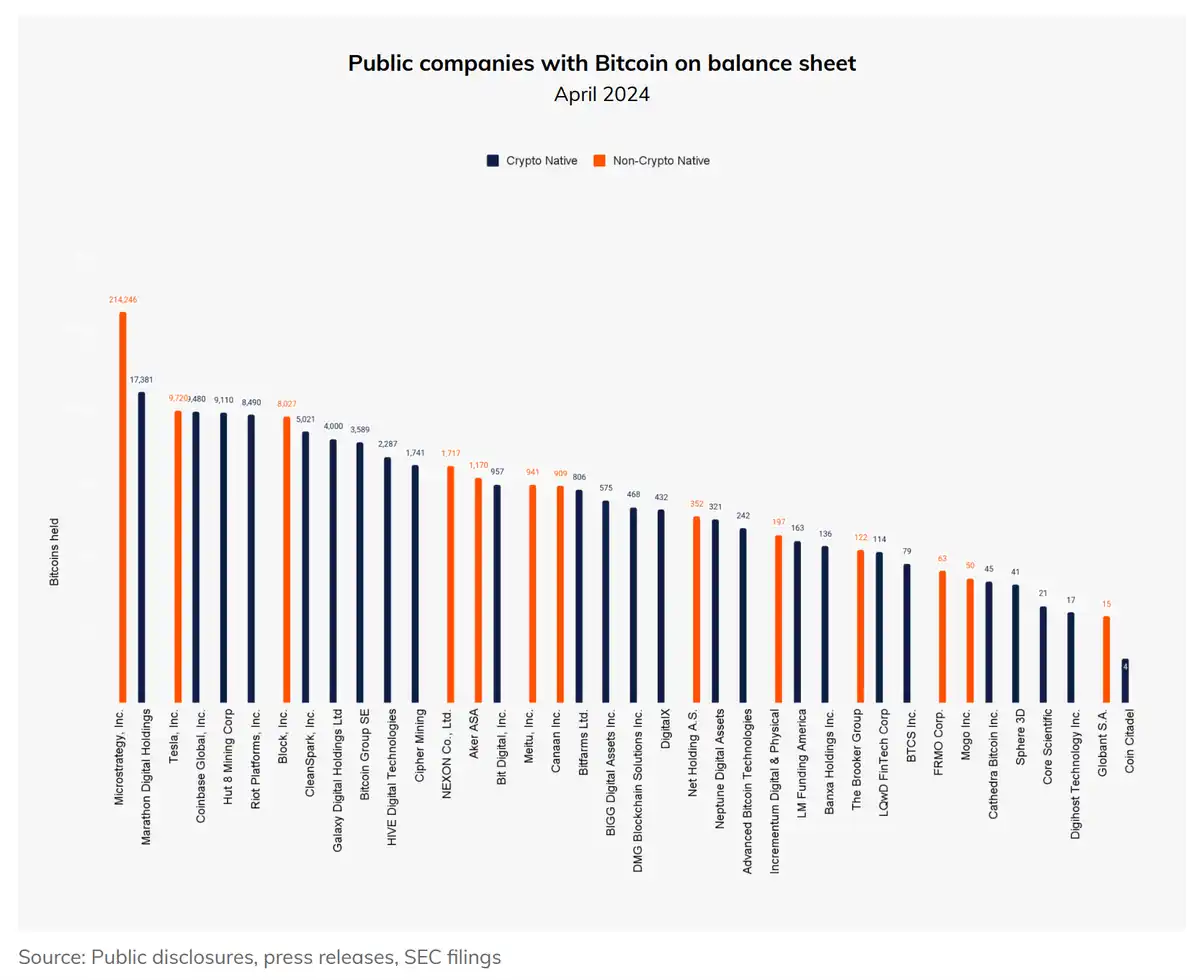
It is estimated that the total on-chain holdings of the Bitcoin ETF have grown to 1.1 million BTC, doubling from the beginning of the year.

Not only crypto-native companies, but many traditional enterprises are also increasing their investments in Bitcoin and other crypto assets. For example, companies like @MicroStrategy led by Saylor continue to add to their Bitcoin holdings, with their current holdings reaching 439,000 BTC.
The Potential of Stablecoins
Stablecoins are a core tool in the cryptocurrency ecosystem, enabling fast asset exchange and serving as a key indicator of new capital inflows.
In 2024, the total supply of stablecoins reached $187.5 billion, setting a new historical high. Meanwhile, stablecoin transaction counts and volumes grew by 30%-40%.
It is worth noting that even amidst market fluctuations, stablecoin transaction volumes remained at high levels—indicating that stablecoins have significant real-world utility beyond trading.

In terms of on-chain stablecoin trading volume, @trondao, @ethereum, @BNBCHAIN, and @solana continue to dominate. Layer 2 networks like @arbitrum and @base are also showing strong momentum in USDC trading volume and user growth.
While centralized exchanges (CEX) currently still lead in trading activity compared to decentralized exchanges (DEX), this landscape is changing.
The USDtb products recently launched by @BlackRock and @ethena_labs provide a secure and convenient way for traditional funds to enter DeFi. With the emergence of these regulated on-ramps, we may see more funds flowing into the on-chain ecosystem in the future.
The Rise of the Stablecoin Market in Latin America and Africa
Over the past year, the stablecoin market in Latin America and Africa has grown by 40%-50%. These regions have a strong demand for trustless currency hedging tools, leading to rapid development of the stablecoin market here.
More and more resources are pouring into these regions, such as the education initiatives launched by @Tether_to and @circle's payment service expansion plans in Latin America. Therefore, we expect this sector to continue its strong growth trajectory in 2025.

Trends in On-Chain Activity
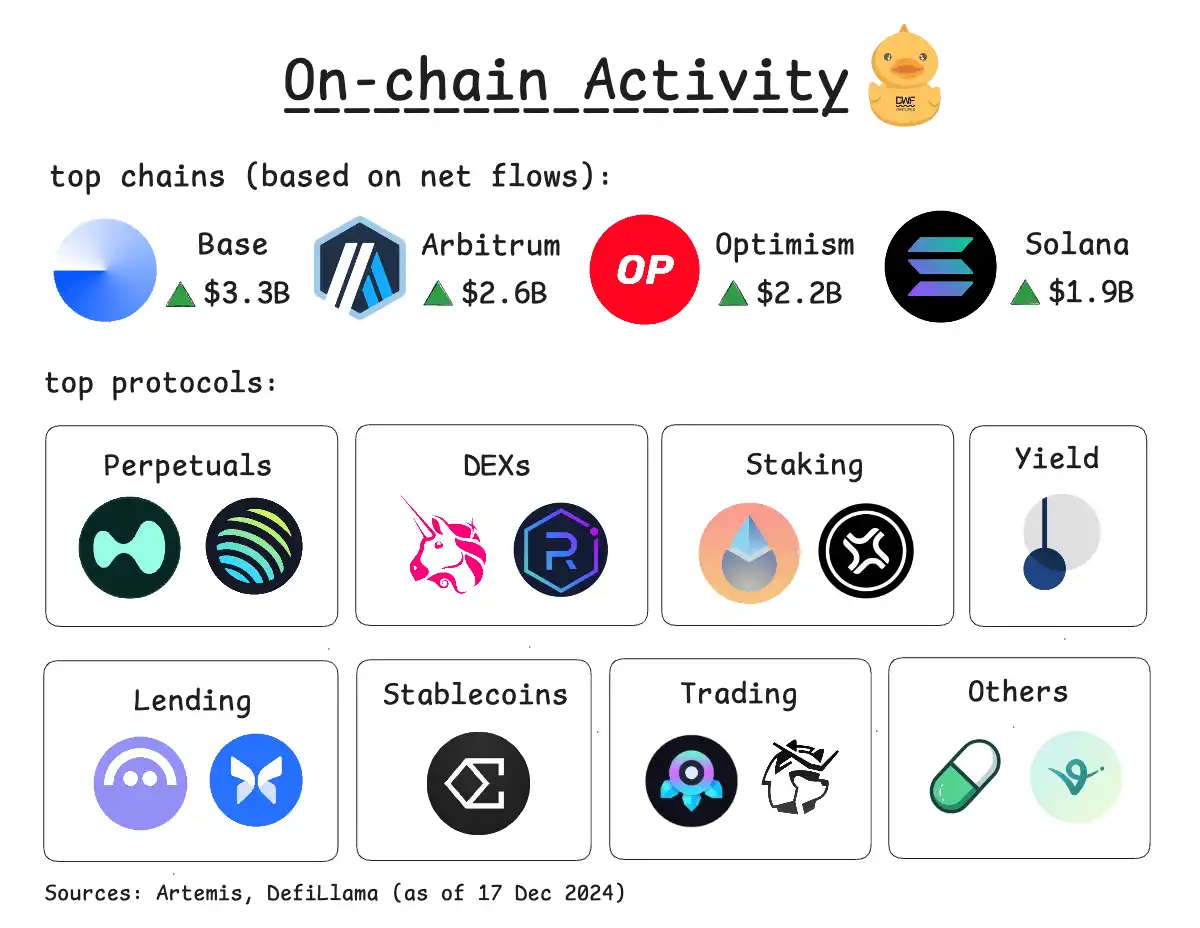
L2 networks (such as @base, @arbitrum, and @Optimism) and non-EVM chains like @solana have shown significant inflows of capital this year. Users are increasingly opting for blockchain networks with lower transaction fees and faster speeds, leading to the attraction of more users to these chains.
The fastest-growing sectors are perpetual contracts and decentralized exchanges (DEX). The trading volumes in these two areas have grown by over 150%, and the total value locked (TVL) has also seen a 2-3x increase. The memecoin craze sparked by @pumpdotfun has greatly boosted trading volumes, with @RaydiumProtocol being one of the major beneficiaries, driving the development of other ecosystems as well. Additionally, this trend has fueled the widespread use of trading bots (such as @tradewithPhoton and @bonkbot_io). These bots are not only highly utilized but have also become one of the highest-earning fee protocols in the current crypto industry.
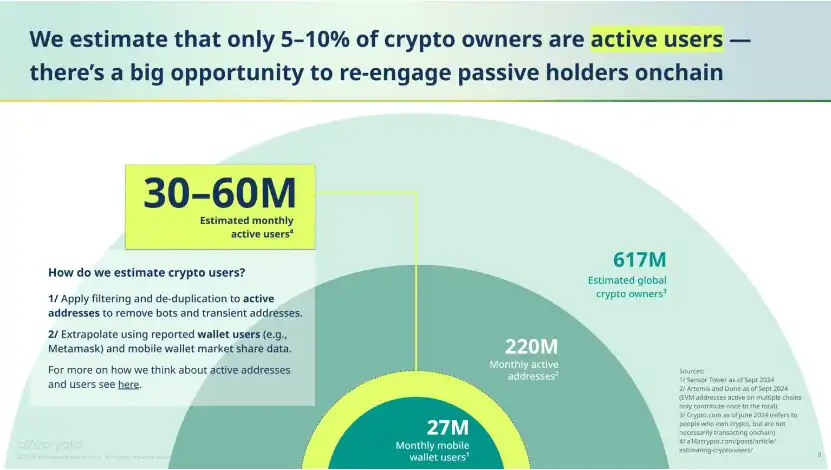
Nevertheless, on-chain activity still has tremendous growth potential. Currently, only 5%-10% of cryptocurrency holders are actively engaged in on-chain operations, meaning there is a large untapped user base.
Mobile-friendly interfaces (such as TON's mini app) have already made significant strides in user growth. For example, @ton_blockchain's mini-app has successfully attracted over 50 million users. Therefore, the future development of protocols will increasingly rely on mechanisms that optimize user experience (UX) and enhance user retention.
You may also like

Fortune Warns of Strategy’s Financing Structure Risks as Bitcoin Premium Narrows
Fortune warned that Strategy’s Bitcoin treasury model faces growing financing risks as MSTR’s net asset premium narrows and preferred stock dividend pressure increases.

Ferrari Challenge Le Mans: Carl Moon to Dominate in WEEX Livery

Sahara AI Responds to SAHARA’s Sharp Drop: No Contract or Product Security Issues Found, Internal Investigation Underway
Sahara AI responded to SAHARA’s 60% price drop, saying no token contract or product security issues have been found and an internal investigation is underway.

WEEX Deposit/Withdrawal Dynamic Island: Your Asset Status, Always in Sight

Scaling Crypto Derivatives: The Digital Asset Infrastructure Behind High-Volume Trading
In the fast-moving digital asset ecosystem, derivatives platforms face an extreme architectural test. High-leverage futures markets demand more than just standard security—they require absolute operational precision, zero-latency matching engines, and ironclad structural scalability, all while navigating intense market volatility.
As global platforms scale to meet these demands, the industry is shifting away from rigid, monolithic setups toward a more agile, "decoupled" infrastructure philosophy.
The Blueprint for High-Volume Copy TradingFor elite global exchanges like WEEX (founded in 2018), this architectural choice becomes critical when scaling high-volume retail features like social copy trading. When thousands of users automatically mirror the real-time strategies of elite traders simultaneously, it triggers sudden, monumental spikes in concurrent transactional volume.
To prevent execution latency or settlement bottlenecks during these peak volatility events, a platform's primary engine must remain entirely dedicated to risk management, copy-trade synchronization, and order matching.
The Architectural Rule: New-generation platforms must separate front-end user execution engines from heavy backend infrastructural overhead to eliminate operational friction.
By separating these layers, platforms can maintain complete sovereignty over their trading environments and user experiences while strategically aligning with institutional-grade infrastructure ecosystems. This strategic framework allows modern exchanges to leverage advanced Digital Asset Custody infrastructure such as Cobo’s behind the scenes, ensuring that backend wallet management scales elastically alongside trading spikes.
Capitalizing on Market Momentum and 400× LeverageIn a derivatives arena where platforms offer up to 400× leverage on perpetual contracts, capital efficiency and market agility are core business metrics. To capture market momentum, an exchange needs the ability to rapidly expand its asset offerings, supporting everything from legacy crypto assets to sudden, trending altcoins across a massive library of trading pairs.
Adopting a flexible, scalable Wallet-as-a-Service (WaaS) solution such as Cobo’s could completely rewrite the development timeline for high-growth exchanges. Instead of spending months of engineering capital building out custom backend wallet architectures for every new blockchain network, platforms can deploy localized infrastructure in days.
This agility allows platforms to instantly scale their listings to over a thousand trading pairs without compromising security or delaying time-to-market. It mirrors the exact operational advantages seen during high-velocity market events, similar to how advanced wallet infrastructure empowers platforms during sudden asset surges; allowing exchanges to pass that speed and liquidity directly to their global user base.
A Mature Foundation for GrowthThe synergy between trusted infrastructure ecosystems and global trading platforms represents the natural evolution of a maturing crypto market. As WEEX continues to scale its global spot and derivatives offerings for over 6 million users, adopting robust backend paradigms proves that platforms no longer have to compromise between cutting-edge trading velocity and uncompromised structural security.

Morning Report | BitMine increased its holdings by 126,971 ETH last week; trader Eugene announced his exit from the crypto market

Wang Chuan: How can one not feel anxious after the neighbor Old Wang made thirty times profit by investing in storage stocks? (Seven) - A quarter-century cycle

Get Paid to Onboard? Try WEEX’s New Homepage with Rewards for Registration, Deposit & Trade

WEEX Custom Layout: Build Your Perfect Trading Workspace in Seconds

See “Buy Walls” & “Sell Walls” Instantly: WEEX Launches the Depth Chart for Smarter Trades

What Is Quick Trade on WEEX? 2 Ways WEEX Ends Chart-Panel Jumping
Morning News | Five major virtual asset platforms in South Korea have experienced 57 incidents of hacking and system failures in six years; Grayscale submits registration application for Canton ETF

Should we escape the peak? The principle of the tail-end market in the stock market

RootData: May 2026 Cryptocurrency Exchange Transparency Research Report

Founder of Baixing.com: My Experience with Claude Code in Fourteen Points

Yang Ge Gary: Agent Economics and AI Microeconomics
When reasoning becomes a scarce resource, who captures its value?

Jensen Huang dramatically "rescues" the South Korean stock market
Fortune Warns of Strategy’s Financing Structure Risks as Bitcoin Premium Narrows
Fortune warned that Strategy’s Bitcoin treasury model faces growing financing risks as MSTR’s net asset premium narrows and preferred stock dividend pressure increases.
Ferrari Challenge Le Mans: Carl Moon to Dominate in WEEX Livery
Sahara AI Responds to SAHARA’s Sharp Drop: No Contract or Product Security Issues Found, Internal Investigation Underway
Sahara AI responded to SAHARA’s 60% price drop, saying no token contract or product security issues have been found and an internal investigation is underway.
WEEX Deposit/Withdrawal Dynamic Island: Your Asset Status, Always in Sight
Scaling Crypto Derivatives: The Digital Asset Infrastructure Behind High-Volume Trading
In the fast-moving digital asset ecosystem, derivatives platforms face an extreme architectural test. High-leverage futures markets demand more than just standard security—they require absolute operational precision, zero-latency matching engines, and ironclad structural scalability, all while navigating intense market volatility.
As global platforms scale to meet these demands, the industry is shifting away from rigid, monolithic setups toward a more agile, "decoupled" infrastructure philosophy.
The Blueprint for High-Volume Copy TradingFor elite global exchanges like WEEX (founded in 2018), this architectural choice becomes critical when scaling high-volume retail features like social copy trading. When thousands of users automatically mirror the real-time strategies of elite traders simultaneously, it triggers sudden, monumental spikes in concurrent transactional volume.
To prevent execution latency or settlement bottlenecks during these peak volatility events, a platform's primary engine must remain entirely dedicated to risk management, copy-trade synchronization, and order matching.
The Architectural Rule: New-generation platforms must separate front-end user execution engines from heavy backend infrastructural overhead to eliminate operational friction.
By separating these layers, platforms can maintain complete sovereignty over their trading environments and user experiences while strategically aligning with institutional-grade infrastructure ecosystems. This strategic framework allows modern exchanges to leverage advanced Digital Asset Custody infrastructure such as Cobo’s behind the scenes, ensuring that backend wallet management scales elastically alongside trading spikes.
Capitalizing on Market Momentum and 400× LeverageIn a derivatives arena where platforms offer up to 400× leverage on perpetual contracts, capital efficiency and market agility are core business metrics. To capture market momentum, an exchange needs the ability to rapidly expand its asset offerings, supporting everything from legacy crypto assets to sudden, trending altcoins across a massive library of trading pairs.
Adopting a flexible, scalable Wallet-as-a-Service (WaaS) solution such as Cobo’s could completely rewrite the development timeline for high-growth exchanges. Instead of spending months of engineering capital building out custom backend wallet architectures for every new blockchain network, platforms can deploy localized infrastructure in days.
This agility allows platforms to instantly scale their listings to over a thousand trading pairs without compromising security or delaying time-to-market. It mirrors the exact operational advantages seen during high-velocity market events, similar to how advanced wallet infrastructure empowers platforms during sudden asset surges; allowing exchanges to pass that speed and liquidity directly to their global user base.
A Mature Foundation for GrowthThe synergy between trusted infrastructure ecosystems and global trading platforms represents the natural evolution of a maturing crypto market. As WEEX continues to scale its global spot and derivatives offerings for over 6 million users, adopting robust backend paradigms proves that platforms no longer have to compromise between cutting-edge trading velocity and uncompromised structural security.
Morning Report | BitMine increased its holdings by 126,971 ETH last week; trader Eugene announced his exit from the crypto market


