
How Does Supra Build an Integrated Future?





The Stage of Public Blockchains Is Far From Over.
Over the past year, the public blockchain space has witnessed a series of revitalizations, sparking renewed interest and discussion. The reincarnation journey led by Solana, Sui's role in the rise of the Move ecosystem, and the pre-mainnet success of Hyperliquid have all reignited the market's imagination in their own ways.
Simultaneously, usability and liquidity have reached unprecedented levels of importance in this process. Consequently, Supra, which promotes an "integrated design" and has quickly garnered significant attention, has also stepped into the spotlight.
From Oracle to Public Blockchain: Supra's Vision
If Supra is unfamiliar to you, then you may have heard of the renowned oracle project SupraOracles. Supra has evolved from SupraOracles because of the team's in-depth research and unique design in on-chain data and cross-chain capabilities. As the project's technical scope continued to expand, the team gradually realized that focusing solely on the oracle module would not fundamentally solve the pain points of blockchain applications in liquidity, randomness, security, and scalability. Thus, the vision of extending from an oracle to a truly high-throughput and highly secure L1 public blockchain began to take shape. According to the official introduction, Supra is steadfastly entering the public blockchain arena because they believe that only by deeply integrating key modules such as oracles, on-chain randomness (dVRF), and cross-chain communication at the base layer can performance and security achieve a "win-win" situation. Once oracles and automation services are unified at the L1 layer, developers will no longer need to connect to multiple networks or numerous external protocols, nor will they need to consider various cross-chain or data security risks, which greatly facilitates the implementation of applications. In pursuit of this goal, in addition to strengthening oracle capabilities, Supra has also made substantial technical preparations at the underlying blockchain and consensus layers, striving to create an "integrated future."
How Does Supra Build an Integrated Future?
The market is no longer interested in the cliché of composability like LEGO but rather values a system that is secure, reliable, and stable. "Integration" often means integrating functions from multiple layers and modules into the same network to achieve a balance between security, performance, and usability. For Supra, the core goal is to allow developers to fulfill various needs such as oracles, cross-chain communication, random numbers (dVRF), and automation on the same public blockchain, eliminating the hassle of frequent integration of external protocols or deploying sidechains. In specific terms, Supra has laid a solid technical and economic foundation for an "integrated future" through the following key modules.
Vertical Integration
In traditional blockchain projects, the underlying layer often only provides core consensus, execution, and data availability, while other functions—such as oracle, cross-chain bridge, automated network, on-chain random number generation, etc.—are handled by external third-party networks or protocols. While this approach provides flexibility, it also leads to various integration issues. Developers may need to switch between multiple networks, ensure compatibility and security audits, resulting in extended development cycles and increased security risks.
Supra, through the concept of "Vertical Integration," embeds these key functions directly into the L1 layer: sharing security guarantees in the same consensus environment, reducing cross-network call latency and vulnerability risks. For developers, this means that applications can easily call services such as random numbers, oracle data, cross-chain communication, etc., in a highly unified ecosystem without the need to repeatedly integrate with external protocols. More importantly, these services all "originate" on the same blockchain, sharing the same security mechanism at the consensus layer, greatly reducing the probability of a "weakest link" leading to systemic risk.
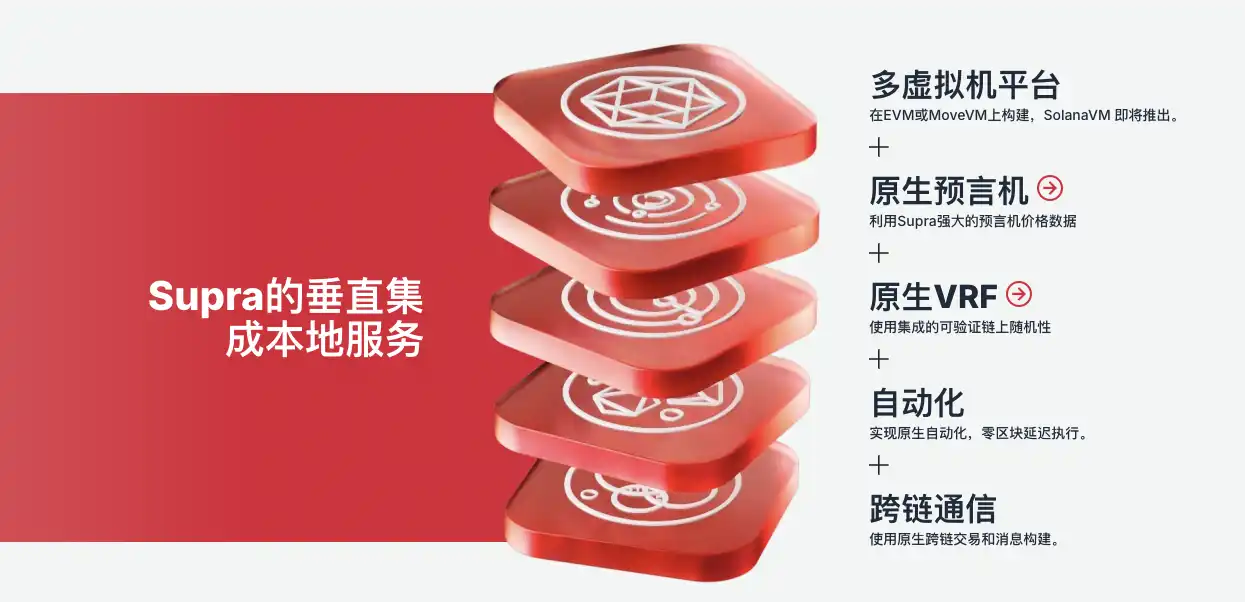
In terms of specific implementation, Supra not only provides a complete set of native cross-chain and oracle solutions but also deeply optimizes data availability and automated execution. By using its proprietary parallelized consensus protocol (Moonshot) to ensure high throughput and sub-second confirmation, Supra's Vertical Integration can bring more feasibility and security guarantees to complex multi-contract interactions, cross-chain transfers, and decentralized autonomous organization (DAO) operations as the functionality continues to expand.
Supra Containers
With the rise of blockchain application chains and Layer2 trends, more and more teams are looking to have autonomous governance models and economic systems. However, the traditional approach often requires building a separate sidechain or application chain, meaning that the project team has to bear the costs of node operation, security audits, and liquidity maintenance. Even with AVS and RaaS, for many small teams, it is still a "thankless task" and easily leads to the "walled garden effect," making it difficult to share liquidity with other applications. Not to mention the dispute between the Degen team and Conduit that led to the migration of the entire Degen L3 chain.
To address these challenges, Supra has introduced the concept of "Containers." A container is like a "microchain attached to the mainnet," where project teams can customize their token model, governance mechanism, or economic incentive scheme within the container, maintaining a relatively independent operational space. At the same time, containers and the Supra mainnet maintain a high level of interoperability: on the one hand, they can share liquidity pools and secure consensus with the mainnet, and on the other hand, containers can also leverage the main chain's built-in oracle, cross-chain communication, and other features in a "plug-and-play" manner.
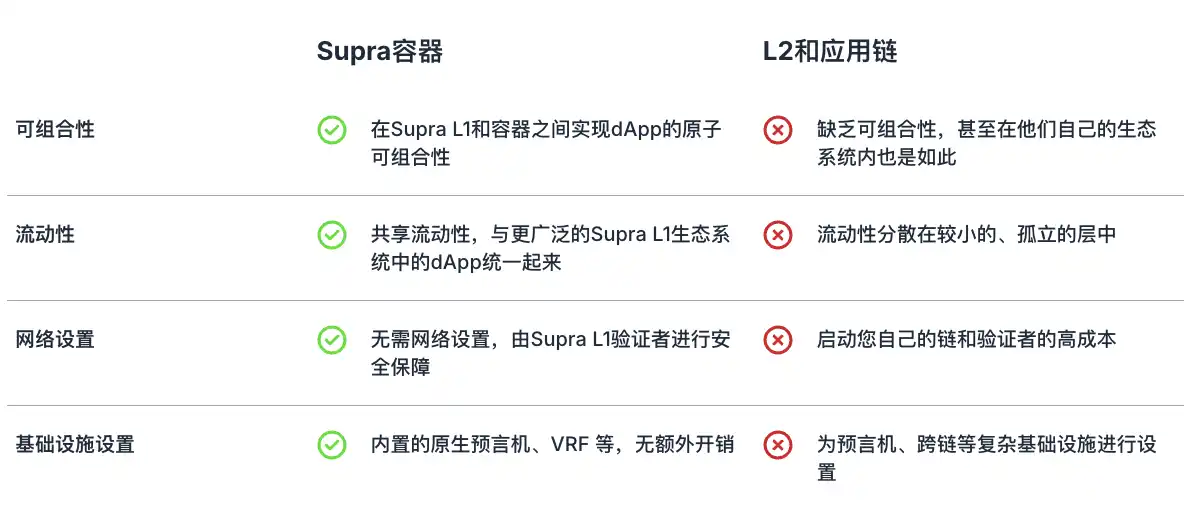
This container mode balances flexibility and security, meeting the project's pursuit of independence without splitting liquidity across multiple chains. For developers, this means they can achieve customized operation similar to an "application chain" without having to bear the heavy burden of node maintenance or security responsibilities, thus eliminating a lot of the cost of reinventing the wheel.
IntraLayer: Decentralized Autonomous Agent
Blockchain applications often require an "unattended" automatic execution method: for example, liquidation logic in a collateralized lending platform, exercise triggers in options protocols, or even random drops in games. Traditionally, these functions may rely on an external keeper network or scripts deployed by developers to monitor contract states and execute operations. While this approach is feasible, it still carries potential centralization dependencies or network failure risks, and also increases the developers' integration burden.
To address this, Supra has introduced the concept of a "Decentralized Autonomous Agent" called IntraLayer, aiming to embed Keeper/Executor-like functions directly on-chain. In other words, nodes in the network can in a decentralized manner detect trigger conditions set by the application on-chain and then automatically execute the corresponding contract logic. In this way, a dApp only needs to register its automated tasks on Supra, without handing over the logic to external scripts or centralized servers for processing.
Because both triggering and execution are done on L1 and combined with Supra's unified security and consensus mechanism, IntraLayer excels in both reliability and security. Once an application entrusts complex automation workflows to IntraLayer, it can maintain a "never-offline" self-running system with fewer manpower and resources, eliminating worries about issues with external keepers.
Proof of Economic Liquidity (PoEL) and Dynamic Function Market Maker (DFMM)
In addition to highly integrating on the technical stack, a public chain's "integration" is also reflected in the linkage between the economic model and the application ecosystem. Through the PoEL (Proof of Economic Liquidity) mechanism, Supra organically combines network security, node staking, and liquidity, encouraging quality capital to enter Supra's mainnet and liquidity pool. As a result, node security and application funding support each other, forming a "win-win" cycle.
Specifically, PoEL allows holders to stake various digital assets into the Supra network, earning corresponding rewards based on asset type and risk exposure. This not only helps the mainnet maintain better liquidity in various scenarios but also enhances the robustness of the network's consensus. With this fund aggregation effect, developers deploying new applications can more easily access liquidity and users, expanding their business scale.
Complementing PoEL is the "Dynamic Functioning Market Maker" (DFMM), which serves as the core matching mechanism provided by Supra for on-chain trading and resource exchange. Unlike traditional AMMs, DFMM places more emphasis on dynamically adjusting market-making parameters based on the network's actual needs and real-time status, thereby more effectively balancing capital utilization and liquidity distribution, reducing impermanent loss or excessive slippage. When combined with Supra's low-latency, high-throughput consensus layer, DFMM has the opportunity to support more complex DeFi scenarios, such as derivative trading and options market making. The integration of PoEL and DFMM can help new projects quickly access the mainnet's liquidity and user resources. Compared to public chain environments that are "rich in technology but lack financial incentives," Supra's financially integrated design may provide developers with more comprehensive support.
Overall, leveraging vertical integration, Moonshot consensus engine, containerized design, IntraLayer decentralized proxy, as well as a series of innovations such as PoEL and DFMM, Supra has built a highly integrated blockchain from underlying technology to economic model. For developers, this means being able to easily utilize key functions such as oracles, cross-chain, automation, and random numbers in a secure and efficient environment, without the need to introduce third-party services or deploy cumbersome cross-chain bridges. For funders and nodes, PoEL provides good returns and security for quality capital, while the dynamic market-making mechanism can drive the prosperity of more DeFi scenarios.
Tokenomics
For any public chain, the tokenomics model is crucial. Supra's token is called SUPRA, and the official statement indicates that its main uses include paying transaction fees, network staking, and applications in various scenarios such as data access. According to the official introduction, SUPRA will also play a significant role under the network's PoEL (Proof of Economic Liquidity) mechanism, encouraging more high-quality assets to enter Supra's liquidity pool to ensure the network's stability and security. PoEL encourages participants to stake various digital assets into the Supra network, receive corresponding incentive rewards, enhance node resilience to risks, and make the token not only a payment and governance tool but also a core element of network liquidity.
Team with Strong Academic Background
If the technical architecture showcases Supra's engineering prowess, then the academic background further strengthens its authority in the cutting-edge cryptography field. The project's Chief Research Officer is Dr. Aniket Kate, one of the inventors of KZG commitments and a cryptographer. The KZG commitment technology plays a key role in Ethereum's scalability roadmap and is also a crucial piece of zero-knowledge proofs. The addition of this scholarly founder has provided solid academic support for Supra's cutting-edge research and foundational innovation. According to the official introduction, the team also comprises other researchers with deep expertise in cryptography, distributed systems, decentralized storage, and other fields, enabling Supra's technical development to maintain a high level both in algorithm and implementation.
Top-tier Backing
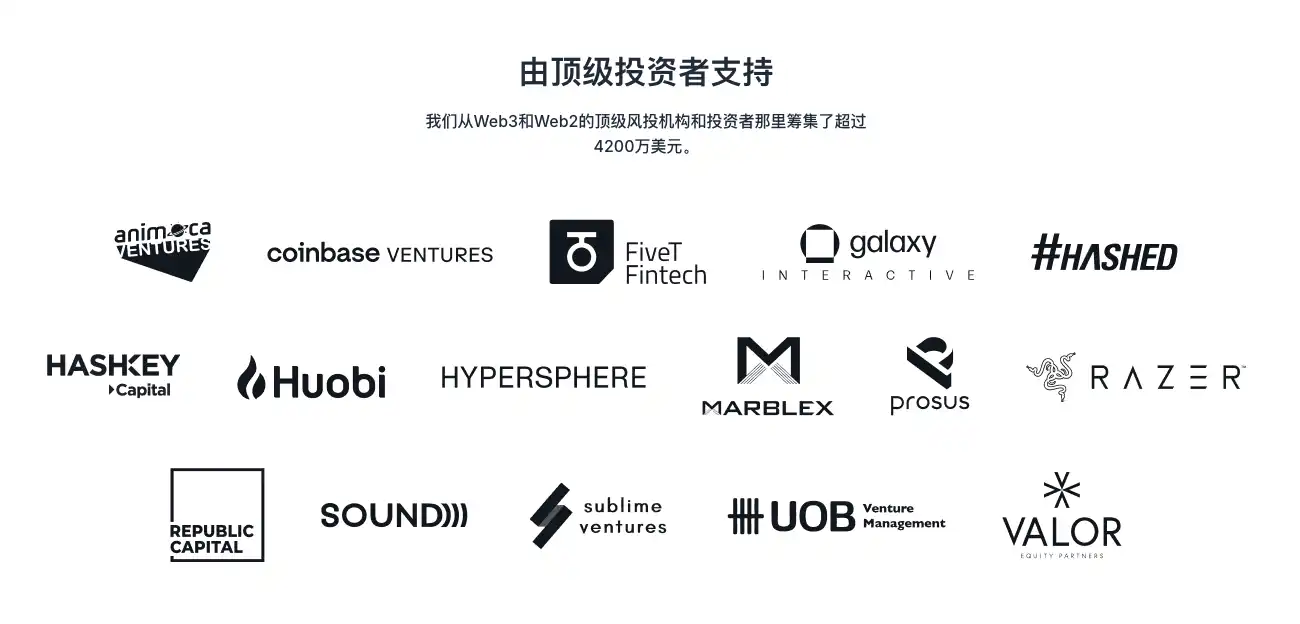
In terms of funding, Supra has already received over $42 million in funding and attracted participation from several well-known institutions, including Coinbase, Hashed, UBO, and Animoca. These investors have extensive resources and industry influence in the blockchain field, providing support for Supra's community building, ecosystem development, and future marketing efforts. Additionally, according to official sources, Supra has also partnered with many well-known projects such as Apechain and Pulme Network to offer support.
Abundant Community Activities
To promote industry development, Supra has launched a $100 million Super dApp Contest, with the team setting aside tokens worth $100 million to support top-tier dApps built on the Supra platform. All winners of the contest will receive a portion of this fund to assist in launching and succeeding in their projects.
While focusing on building core technology and a community ecosystem, Supra also places great emphasis on industry collaboration and promotion. According to official information, the team has participated in or hosted multiple blockchain summits and hackathons in 2024 and has conducted several AMAs in the community. Through these offline and online activities, Supra has not only attracted developers and community members from around the world but has also gained insights into various application scenarios' pain points through real conversations, enabling better iteration of the project roadmap.
Looking across the entire public chain landscape, a high-performance, scalable, and highly secure single-chain solution remains the ideal answer for many developers and users. However, in recent times, various implementation approaches and solutions have made the competition fierce and complex. Supra's emergence has injected new imagination into this track, as they have chosen to directly integrate at the L1 level in a full-stack manner, enabling oracles, cross-chain communication, random numbers, and automation to be natively implemented on the mainnet, aiming to simplify development costs and integration risks. As the Supra mainnet gradually matures, whether this integrated framework can truly become a new benchmark for public chains remains to be tested by more real-world applications and the community. But at least from the current design philosophy and architectural approach, Supra is embarking on a path of innovation that emphasizes both technical integration and economic linkage.
Further Reading: "Technical Guide: A Comprehensive Explanation of the Supra Blockchain Technology Stack"
You may also like

Japan’s Three Megabanks Plan Joint Stablecoin Issuance in Fiscal 2026
MUFG, SMBC, and Mizuho reportedly plan to jointly issue fiat-pegged stablecoins in fiscal 2026, signaling Japan’s growing push into bank-led digital payment infrastructure.

Humanity Discloses H Token Dual-Chain Attack Details, With Losses on Ethereum and BSC Exceeding $36 Million
Humanity said the H token attack across Ethereum and BSC caused more than $36 million in losses after leaked ProxyAdmin keys enabled malicious contract upgrades and token minting.

White House Discusses CLARITY Act With Law Enforcement Ahead of Senate Vote
The White House discussed the CLARITY Act with law enforcement ahead of a Senate vote, focusing on illicit finance risks and developer protections.

$75 billion in foreign capital has fled, and South Korean retail investors have absorbed it all using leverage

Bitcoin Trading Guide 2026: Strategies for Experienced Traders

What Is XAUT and PAXG? Why Tokenized Gold Is Booming in 2026

Cryptocurrency CEXs are flocking to sell US stocks, and traditional brokerages are facing an "uninvited guest."

Will the SpaceX IPO Hurt Bitcoin? Here's What Traders Are Watching
Foreign selling in the South Korean stock market accelerates, with cumulative net sales reportedly reaching $75 billion this year
On June 9, The Kobeissi Letter, citing Goldman Sachs data, reported that global investors are selling South Korean stocks at an unusually rapid pace. In the latest trading session, foreign investors sold about $801 million worth of Kospi constituent stocks again; total foreign outflows last week reached about $10 billion, and the market has been in net foreign selling on nearly every trading day over the past month. According to the data cited in the report, foreign investors have sold about $75 billion worth of South Korean stocks so far this year. Meanwhile, South Korean retail and institutional investors together recorded roughly $69 billion in net buying over the same period, suggesting that the market’s main buying support has come from domestic capital rather than returning overseas funds. The information currently disclosed still mainly comes from The Kobeissi Letter’s retelling and Goldman Sachs data summaries, while public details on the statistical period and the specific definition of “selling” remain relatively limited.

Fortune Warns of Strategy’s Financing Structure Risks as Bitcoin Premium Narrows
Fortune warned that Strategy’s Bitcoin treasury model faces growing financing risks as MSTR’s net asset premium narrows and preferred stock dividend pressure increases.

Ferrari Challenge Le Mans: Carl Moon to Dominate in WEEX Livery

Sahara AI Responds to SAHARA’s Sharp Drop: No Contract or Product Security Issues Found, Internal Investigation Underway
Sahara AI responded to SAHARA’s 60% price drop, saying no token contract or product security issues have been found and an internal investigation is underway.

WEEX Deposit/Withdrawal Dynamic Island: Your Asset Status, Always in Sight
Scaling Crypto Derivatives: The Digital Asset Infrastructure Behind High-Volume Trading
In the fast-moving digital asset ecosystem, derivatives platforms face an extreme architectural test. High-leverage futures markets demand more than just standard security—they require absolute operational precision, zero-latency matching engines, and ironclad structural scalability, all while navigating intense market volatility.
As global platforms scale to meet these demands, the industry is shifting away from rigid, monolithic setups toward a more agile, "decoupled" infrastructure philosophy.
The Blueprint for High-Volume Copy TradingFor elite global exchanges like WEEX (founded in 2018), this architectural choice becomes critical when scaling high-volume retail features like social copy trading. When thousands of users automatically mirror the real-time strategies of elite traders simultaneously, it triggers sudden, monumental spikes in concurrent transactional volume.
To prevent execution latency or settlement bottlenecks during these peak volatility events, a platform's primary engine must remain entirely dedicated to risk management, copy-trade synchronization, and order matching.
The Architectural Rule: New-generation platforms must separate front-end user execution engines from heavy backend infrastructural overhead to eliminate operational friction.
By separating these layers, platforms can maintain complete sovereignty over their trading environments and user experiences while strategically aligning with institutional-grade infrastructure ecosystems. This strategic framework allows modern exchanges to leverage advanced Digital Asset Custody infrastructure such as Cobo’s behind the scenes, ensuring that backend wallet management scales elastically alongside trading spikes.
Capitalizing on Market Momentum and 400× LeverageIn a derivatives arena where platforms offer up to 400× leverage on perpetual contracts, capital efficiency and market agility are core business metrics. To capture market momentum, an exchange needs the ability to rapidly expand its asset offerings, supporting everything from legacy crypto assets to sudden, trending altcoins across a massive library of trading pairs.
Adopting a flexible, scalable Wallet-as-a-Service (WaaS) solution such as Cobo’s could completely rewrite the development timeline for high-growth exchanges. Instead of spending months of engineering capital building out custom backend wallet architectures for every new blockchain network, platforms can deploy localized infrastructure in days.
This agility allows platforms to instantly scale their listings to over a thousand trading pairs without compromising security or delaying time-to-market. It mirrors the exact operational advantages seen during high-velocity market events, similar to how advanced wallet infrastructure empowers platforms during sudden asset surges; allowing exchanges to pass that speed and liquidity directly to their global user base.
A Mature Foundation for GrowthThe synergy between trusted infrastructure ecosystems and global trading platforms represents the natural evolution of a maturing crypto market. As WEEX continues to scale its global spot and derivatives offerings for over 6 million users, adopting robust backend paradigms proves that platforms no longer have to compromise between cutting-edge trading velocity and uncompromised structural security.

Morning Report | BitMine increased its holdings by 126,971 ETH last week; trader Eugene announced his exit from the crypto market

Wang Chuan: How can one not feel anxious after the neighbor Old Wang made thirty times profit by investing in storage stocks? (Seven) - A quarter-century cycle

Get Paid to Onboard? Try WEEX’s New Homepage with Rewards for Registration, Deposit & Trade
WEEX Custom Layout: Build Your Perfect Trading Workspace in Seconds
Japan’s Three Megabanks Plan Joint Stablecoin Issuance in Fiscal 2026
MUFG, SMBC, and Mizuho reportedly plan to jointly issue fiat-pegged stablecoins in fiscal 2026, signaling Japan’s growing push into bank-led digital payment infrastructure.
Humanity Discloses H Token Dual-Chain Attack Details, With Losses on Ethereum and BSC Exceeding $36 Million
Humanity said the H token attack across Ethereum and BSC caused more than $36 million in losses after leaked ProxyAdmin keys enabled malicious contract upgrades and token minting.
White House Discusses CLARITY Act With Law Enforcement Ahead of Senate Vote
The White House discussed the CLARITY Act with law enforcement ahead of a Senate vote, focusing on illicit finance risks and developer protections.
$75 billion in foreign capital has fled, and South Korean retail investors have absorbed it all using leverage
Bitcoin Trading Guide 2026: Strategies for Experienced Traders
What Is XAUT and PAXG? Why Tokenized Gold Is Booming in 2026


