
HYPE Faces Over 20% Daily Pullback, North Korean Hackers Targeting Hyperliquid?


Original Title: "HYPE Sees Over 20% Daily Pullback, Is North Korea Hacker Eyeing Hyperliquid?"
Original Author: Azuma, Odaily Planet Daily
The popular project Hyperliquid (HYPE) experienced its largest pullback since launching today.
Bitget data shows that as of around 14:00 Beijing time, HYPE was trading at 26.21 USDT, marking a sharp 20.5% intraday decline.
Is North Korea Hacker Eyeing Hyperliquid?
Looking at the market news, the biggest event in the Hyperliquid community discussion today was a warning from well-known security researcher Tay (@tayvano_) — multiple flagged North Korean hacker addresses have recently been transacting on Hyperliquid, resulting in a total loss of over $700,000.
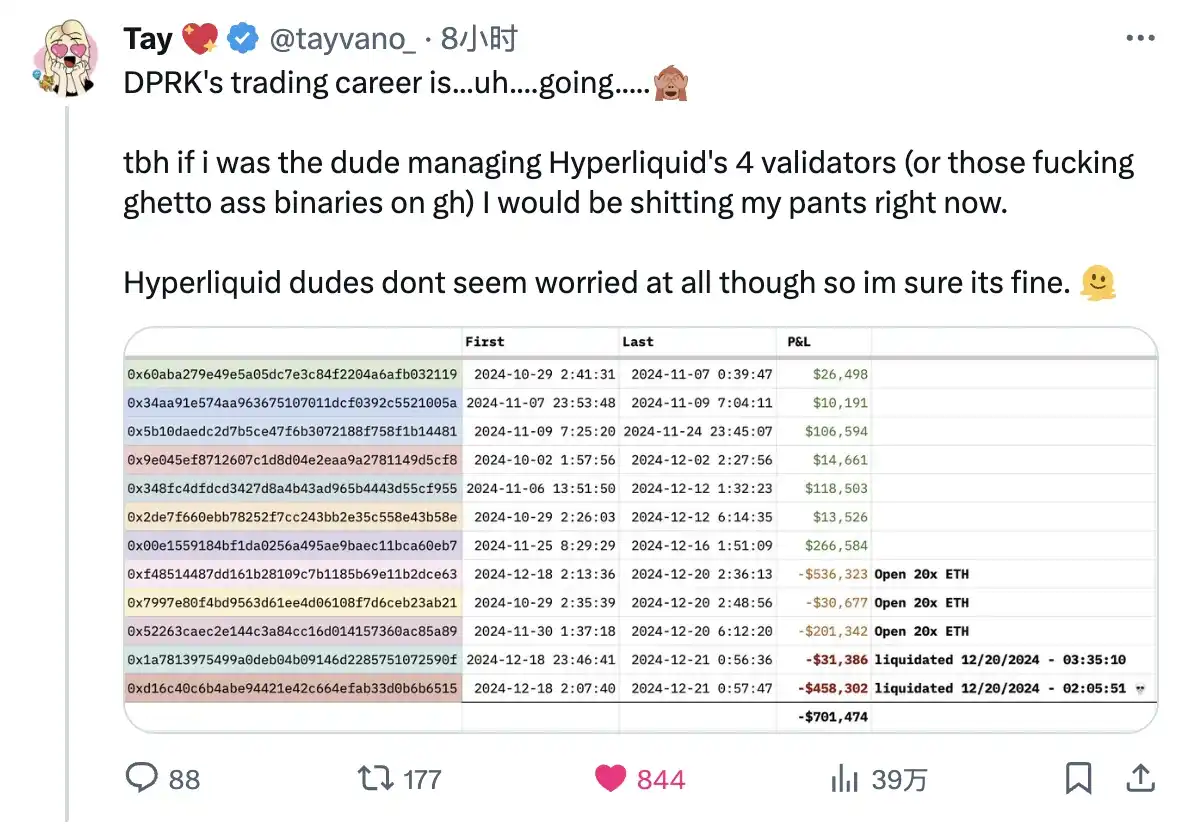
While as of the time of writing, there have been no signs of any attack on Hyperliquid, but as Tay stated, "If I were one of the 4 validators managing Hyperliquid, I might be peeing my pants right now"... signs of activity from the strongest hacker forces in the cryptocurrency world, could mean that North Korean hackers have identified Hyperliquid as a potential target and are testing the system's stability through transactions.
After Tay's post, it immediately sparked heated discussions within the community, especially the issue of the "4 validators" mentioned by Tay, which some community members even see as the weakest link in the current Hyperliquid system security.
Potential Threat: $2.3 Billion Depending Solely on 3/4 Multisig
Abstract developer cygaar explained that the Hyperliquid bridging contract currently deployed on Arbitrum holds a total of $2.3 billion in USDC, with most functions in this bridging contract requiring 2/3 validator signatures to execute (as there are only 4 validators, this effectively requires 3 signatures).
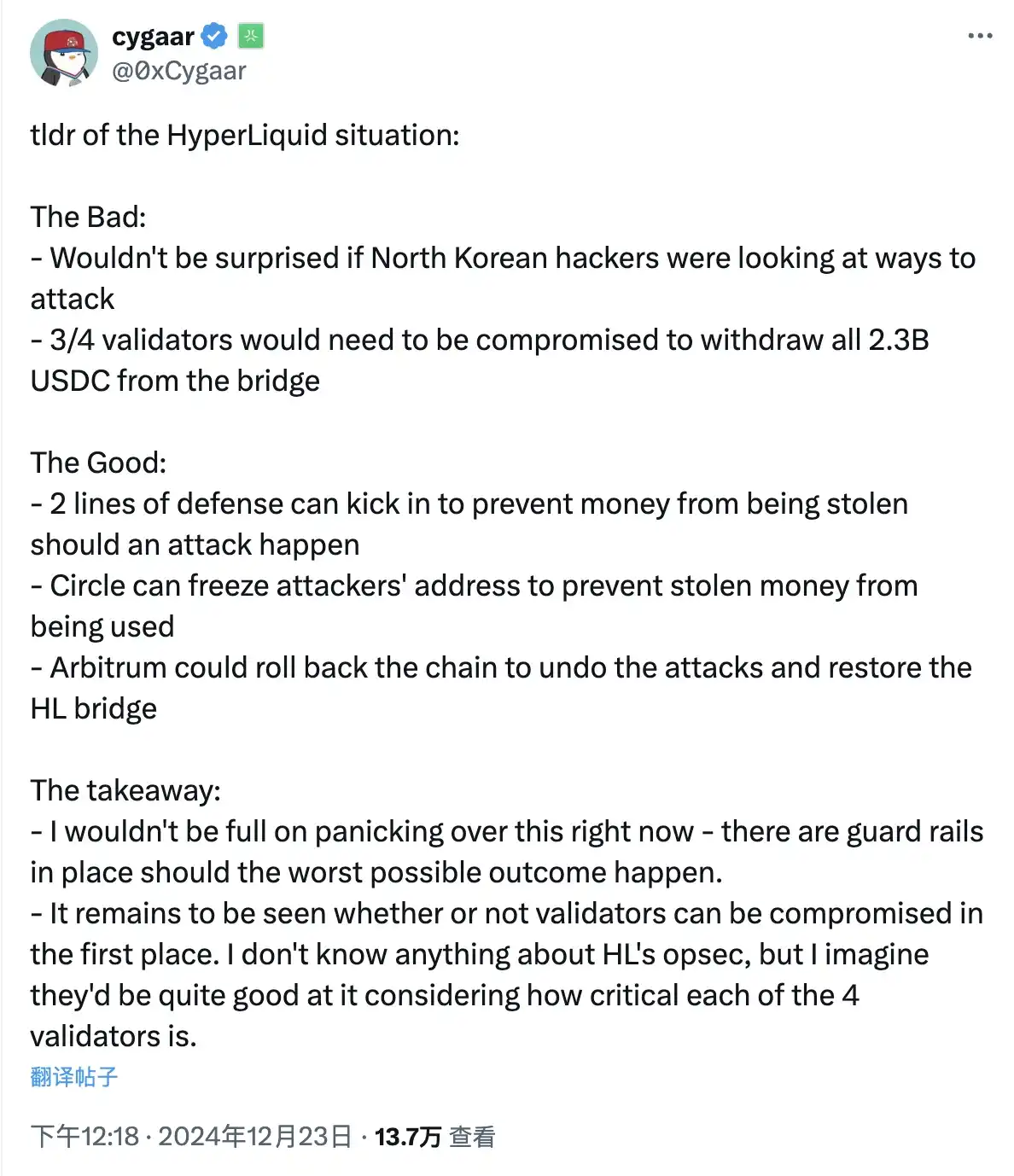
Assuming that a majority (3/4) of validators are compromised, the breached validators can submit a request to withdraw all USDC from the bridge contract and send them to a malicious address. Since the attacker has control of the vast majority of validators, they will be able to smoothly pass the request and ultimately finalize the withdrawal, meaning that $2.3 billion USDC will be transferred to the attacker.
Currently, there are two lines of defense that can intervene to prevent these USDC from being permanently lost.
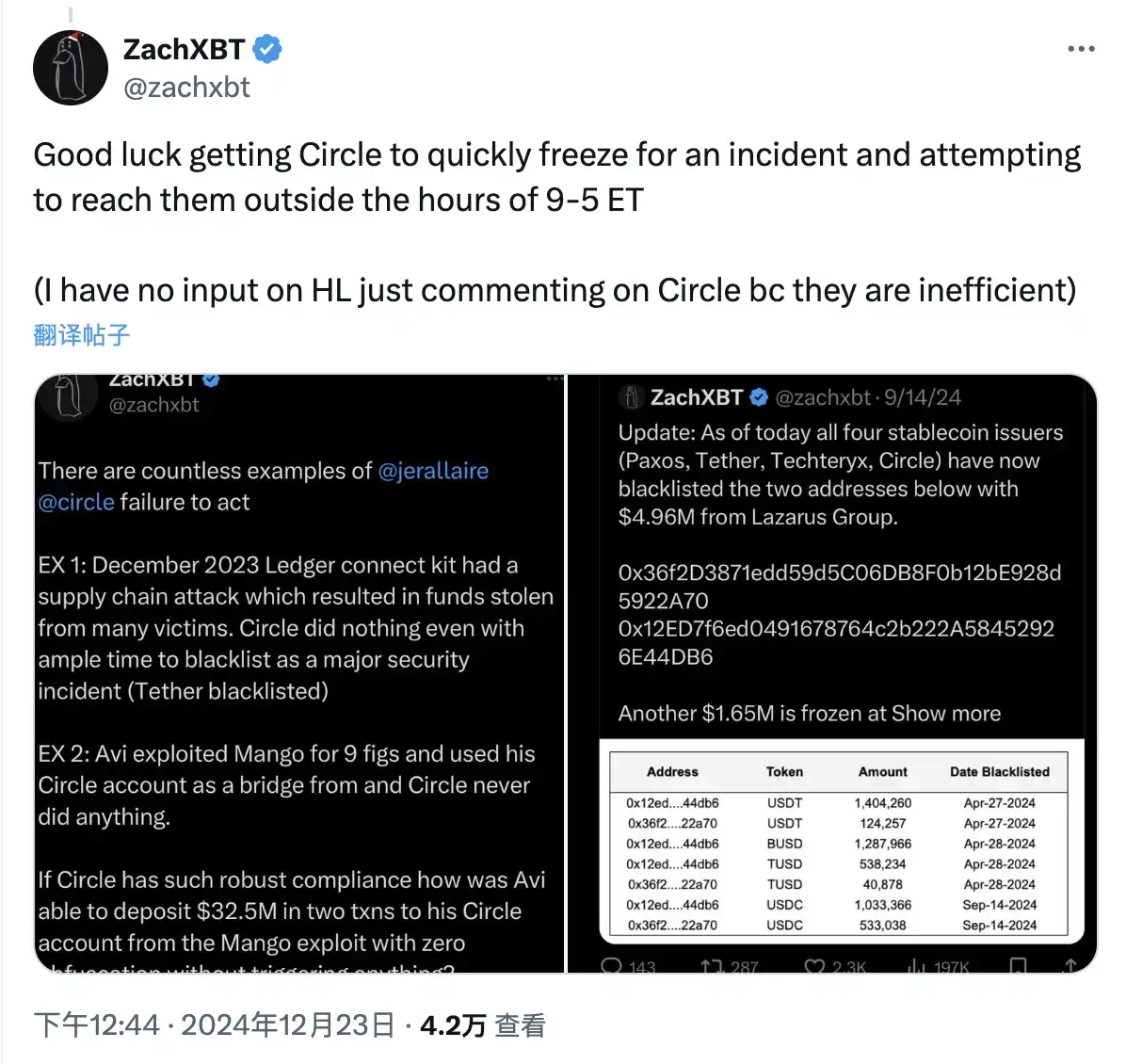
The first line of defense is at the USDC contract level. Circle's blacklist mechanism can entirely prevent specific addresses from transferring USDC. If they act fast enough, they can stop the attacker from transferring the stolen USDC, effectively freezing the funds and reimbursing the Hyperliquid bridge contract.
Regarding this defense line, security guru ZachXBT commented that Circle is very inefficient, and one should not expect them to take any remedial action. However, ZachXBT also clarified that this comment is only directed at Circle and does not involve an opinion on Hyperliquid.
The second line of defense is at the Arbitrum network level. Currently, the Arbitrum L1/L2 bridge contract on Ethereum is protected by a 9/12 multi-signature contract (security council). Suppose the attacker somehow controls this $2.3 billion USDC and immediately swaps it for other tokens to circumvent Circle's blacklist mechanism. In theory, Arbitrum's security council can also change the chain's state, roll back, and prevent the initial attack transaction from occurring. In an "emergency," the council can vote to decide whether to undertake this intervention.
cygaar added that the final line of defense is evidently highly controversial and should only be used in the most dire circumstances.
「Intentional FUD」 or 「Well-intended Warning」? Community Reaction Divided
In response to Tay's warning post, the community reaction has shown a stark dichotomy.
On one hand, some community members believe that Tay's warning is exaggerated, especially after the decline in HYPE, with many in the community considering Tay to be merely spreading "intentional FUD".
· Some community members pointed out that North Korean hackers target every protocol with a high TVL, not just Hyperliquid. Discovering the hacker's traces does not necessarily mean the protocol has been compromised;
· Some community members also mentioned that Tay himself actually works for Consensys, raising suspicions of a conflict of interest in his so-called "warning." In reality, it may just be to ensure that Consensys can secure the most advantageous cooperation with the Hyperliquid team.

On the other hand, some well-known figures have chosen to support Tay's security work.
· Renowned white-hat hacker samczsun stated that despite Tay's years of pro bono service to the cryptocurrency industry, he faced intense criticism due to this post simply because HYPE's price experienced a significant drop after the warning was issued... it's sad to see such news.
· Wintermute's founder and CEO, Evgeny Gaevoy, also mentioned that Tay's communication style may be somewhat aggressive (after this tweet was posted, Tay engaged in heated arguments with some of the users accusing him), but you cannot overlook information like this.

Overall, for Hyperliquid, which has been sailing smoothly since its launch, today's discussion can be considered a somewhat significant incident in the project's operation. It's called significant because Hyperliquid was not actually attacked; however, certain vulnerable aspects of the Hyperliquid system were exposed, and there was a certain degree of community division in this event... but as a leader aspiring to revolutionize industry norms, this incident is more of a litmus test than a hardship. How Hyperliquid will address the 3/4 multisig issue and calm UFD will also be a great opportunity for the market to reevaluate the project's quality and efficiency.
You may also like

Fortune Warns of Strategy’s Financing Structure Risks as Bitcoin Premium Narrows
Fortune warned that Strategy’s Bitcoin treasury model faces growing financing risks as MSTR’s net asset premium narrows and preferred stock dividend pressure increases.

Ferrari Challenge Le Mans: Carl Moon to Dominate in WEEX Livery

Sahara AI Responds to SAHARA’s Sharp Drop: No Contract or Product Security Issues Found, Internal Investigation Underway
Sahara AI responded to SAHARA’s 60% price drop, saying no token contract or product security issues have been found and an internal investigation is underway.

WEEX Deposit/Withdrawal Dynamic Island: Your Asset Status, Always in Sight

Scaling Crypto Derivatives: The Digital Asset Infrastructure Behind High-Volume Trading
In the fast-moving digital asset ecosystem, derivatives platforms face an extreme architectural test. High-leverage futures markets demand more than just standard security—they require absolute operational precision, zero-latency matching engines, and ironclad structural scalability, all while navigating intense market volatility.
As global platforms scale to meet these demands, the industry is shifting away from rigid, monolithic setups toward a more agile, "decoupled" infrastructure philosophy.
The Blueprint for High-Volume Copy TradingFor elite global exchanges like WEEX (founded in 2018), this architectural choice becomes critical when scaling high-volume retail features like social copy trading. When thousands of users automatically mirror the real-time strategies of elite traders simultaneously, it triggers sudden, monumental spikes in concurrent transactional volume.
To prevent execution latency or settlement bottlenecks during these peak volatility events, a platform's primary engine must remain entirely dedicated to risk management, copy-trade synchronization, and order matching.
The Architectural Rule: New-generation platforms must separate front-end user execution engines from heavy backend infrastructural overhead to eliminate operational friction.
By separating these layers, platforms can maintain complete sovereignty over their trading environments and user experiences while strategically aligning with institutional-grade infrastructure ecosystems. This strategic framework allows modern exchanges to leverage advanced Digital Asset Custody infrastructure such as Cobo’s behind the scenes, ensuring that backend wallet management scales elastically alongside trading spikes.
Capitalizing on Market Momentum and 400× LeverageIn a derivatives arena where platforms offer up to 400× leverage on perpetual contracts, capital efficiency and market agility are core business metrics. To capture market momentum, an exchange needs the ability to rapidly expand its asset offerings, supporting everything from legacy crypto assets to sudden, trending altcoins across a massive library of trading pairs.
Adopting a flexible, scalable Wallet-as-a-Service (WaaS) solution such as Cobo’s could completely rewrite the development timeline for high-growth exchanges. Instead of spending months of engineering capital building out custom backend wallet architectures for every new blockchain network, platforms can deploy localized infrastructure in days.
This agility allows platforms to instantly scale their listings to over a thousand trading pairs without compromising security or delaying time-to-market. It mirrors the exact operational advantages seen during high-velocity market events, similar to how advanced wallet infrastructure empowers platforms during sudden asset surges; allowing exchanges to pass that speed and liquidity directly to their global user base.
A Mature Foundation for GrowthThe synergy between trusted infrastructure ecosystems and global trading platforms represents the natural evolution of a maturing crypto market. As WEEX continues to scale its global spot and derivatives offerings for over 6 million users, adopting robust backend paradigms proves that platforms no longer have to compromise between cutting-edge trading velocity and uncompromised structural security.

Morning Report | BitMine increased its holdings by 126,971 ETH last week; trader Eugene announced his exit from the crypto market

Wang Chuan: How can one not feel anxious after the neighbor Old Wang made thirty times profit by investing in storage stocks? (Seven) - A quarter-century cycle

Get Paid to Onboard? Try WEEX’s New Homepage with Rewards for Registration, Deposit & Trade
WEEX Custom Layout: Build Your Perfect Trading Workspace in Seconds

See “Buy Walls” & “Sell Walls” Instantly: WEEX Launches the Depth Chart for Smarter Trades

What Is Quick Trade on WEEX? 2 Ways WEEX Ends Chart-Panel Jumping
Morning News | Five major virtual asset platforms in South Korea have experienced 57 incidents of hacking and system failures in six years; Grayscale submits registration application for Canton ETF

Should we escape the peak? The principle of the tail-end market in the stock market

RootData: May 2026 Cryptocurrency Exchange Transparency Research Report

Founder of Baixing.com: My Experience with Claude Code in Fourteen Points

Yang Ge Gary: Agent Economics and AI Microeconomics
When reasoning becomes a scarce resource, who captures its value?

Jensen Huang dramatically "rescues" the South Korean stock market
Fortune Warns of Strategy’s Financing Structure Risks as Bitcoin Premium Narrows
Fortune warned that Strategy’s Bitcoin treasury model faces growing financing risks as MSTR’s net asset premium narrows and preferred stock dividend pressure increases.
Ferrari Challenge Le Mans: Carl Moon to Dominate in WEEX Livery
Sahara AI Responds to SAHARA’s Sharp Drop: No Contract or Product Security Issues Found, Internal Investigation Underway
Sahara AI responded to SAHARA’s 60% price drop, saying no token contract or product security issues have been found and an internal investigation is underway.
WEEX Deposit/Withdrawal Dynamic Island: Your Asset Status, Always in Sight
Scaling Crypto Derivatives: The Digital Asset Infrastructure Behind High-Volume Trading
In the fast-moving digital asset ecosystem, derivatives platforms face an extreme architectural test. High-leverage futures markets demand more than just standard security—they require absolute operational precision, zero-latency matching engines, and ironclad structural scalability, all while navigating intense market volatility.
As global platforms scale to meet these demands, the industry is shifting away from rigid, monolithic setups toward a more agile, "decoupled" infrastructure philosophy.
The Blueprint for High-Volume Copy TradingFor elite global exchanges like WEEX (founded in 2018), this architectural choice becomes critical when scaling high-volume retail features like social copy trading. When thousands of users automatically mirror the real-time strategies of elite traders simultaneously, it triggers sudden, monumental spikes in concurrent transactional volume.
To prevent execution latency or settlement bottlenecks during these peak volatility events, a platform's primary engine must remain entirely dedicated to risk management, copy-trade synchronization, and order matching.
The Architectural Rule: New-generation platforms must separate front-end user execution engines from heavy backend infrastructural overhead to eliminate operational friction.
By separating these layers, platforms can maintain complete sovereignty over their trading environments and user experiences while strategically aligning with institutional-grade infrastructure ecosystems. This strategic framework allows modern exchanges to leverage advanced Digital Asset Custody infrastructure such as Cobo’s behind the scenes, ensuring that backend wallet management scales elastically alongside trading spikes.
Capitalizing on Market Momentum and 400× LeverageIn a derivatives arena where platforms offer up to 400× leverage on perpetual contracts, capital efficiency and market agility are core business metrics. To capture market momentum, an exchange needs the ability to rapidly expand its asset offerings, supporting everything from legacy crypto assets to sudden, trending altcoins across a massive library of trading pairs.
Adopting a flexible, scalable Wallet-as-a-Service (WaaS) solution such as Cobo’s could completely rewrite the development timeline for high-growth exchanges. Instead of spending months of engineering capital building out custom backend wallet architectures for every new blockchain network, platforms can deploy localized infrastructure in days.
This agility allows platforms to instantly scale their listings to over a thousand trading pairs without compromising security or delaying time-to-market. It mirrors the exact operational advantages seen during high-velocity market events, similar to how advanced wallet infrastructure empowers platforms during sudden asset surges; allowing exchanges to pass that speed and liquidity directly to their global user base.
A Mature Foundation for GrowthThe synergy between trusted infrastructure ecosystems and global trading platforms represents the natural evolution of a maturing crypto market. As WEEX continues to scale its global spot and derivatives offerings for over 6 million users, adopting robust backend paradigms proves that platforms no longer have to compromise between cutting-edge trading velocity and uncompromised structural security.
Morning Report | BitMine increased its holdings by 126,971 ETH last week; trader Eugene announced his exit from the crypto market


