
Raised $20 Million for Daughter's Medical Bills in Three Hours, "Web3 Crowdfunding" MIRA's Christmas Miracle


“If you could press a button to immediately end your own life and cure a child's brain tumor as a result, every parent would not hesitate to be the first to press the button. But the cruelest part is, such a button simply does not exist,” Mira's dad, Chen Siqi, wrote on Twitter. His calm yet loving words reveal his helplessness and bewilderment.
The Story Behind the Death Button
On September 23 this year, Chen Siqi's daughter Mira was diagnosed with a rare brain tumor called craniopharyngioma. Although this tumor is benign, it is located in a very dangerous part of the brain, and any slight mistake could lead Mira to suffer from the disease and lose her ability to take care of herself.
Chen Siqi has been actively collaborating with Dr. Todd Hankinson from the University of Colorado, the only one in the world studying this tumor, to secure bi-weekly intravenous injection trials for his daughter to suppress the tumor's growth. However, there is currently no fully effective treatment for this tumor, and researching such a rare disease requires substantial financial support. So, this Christmas, Chen Siqi embarked on his web3 "crowdfunding" journey.
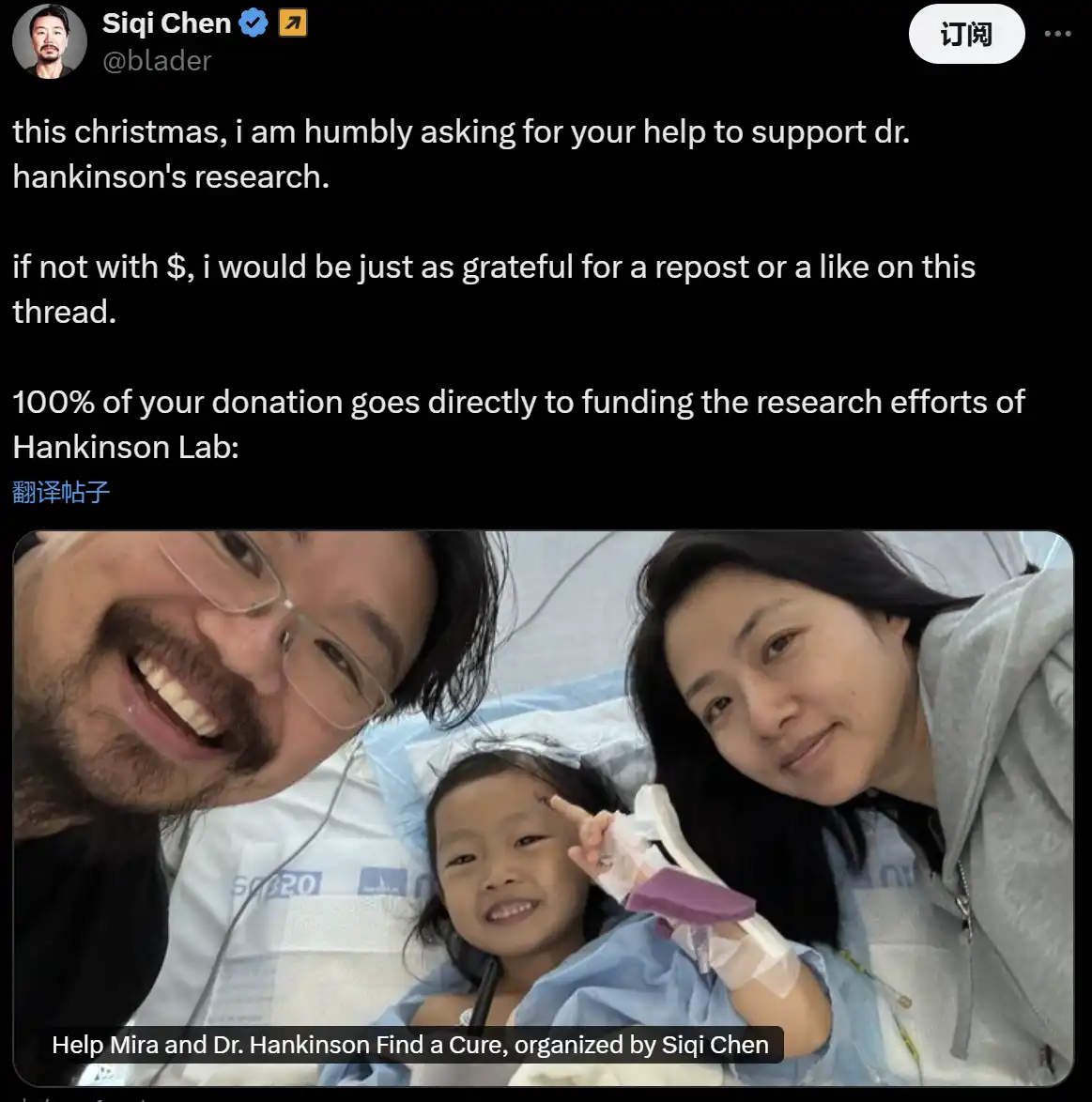
Chen Siqi began posting on Twitter, calling on netizens to donate to Hankinson's lab. A movement to save the girl Mira unfolded on Twitter, with heavyweights such as former Uber CEO Ronak and hellopatient co-founder Alex stepping up for Mira.
It seems the heavens heard every helpless cry from Chen Siqi in the corner of the room, saw every tear he secretly wiped behind the door. Within just 3 hours after Chen Siqi's post, he quickly raised $75,000 through gofund.me. As of now, Chen Siqi has raised $224,000, 25% away from his $300,000 goal.
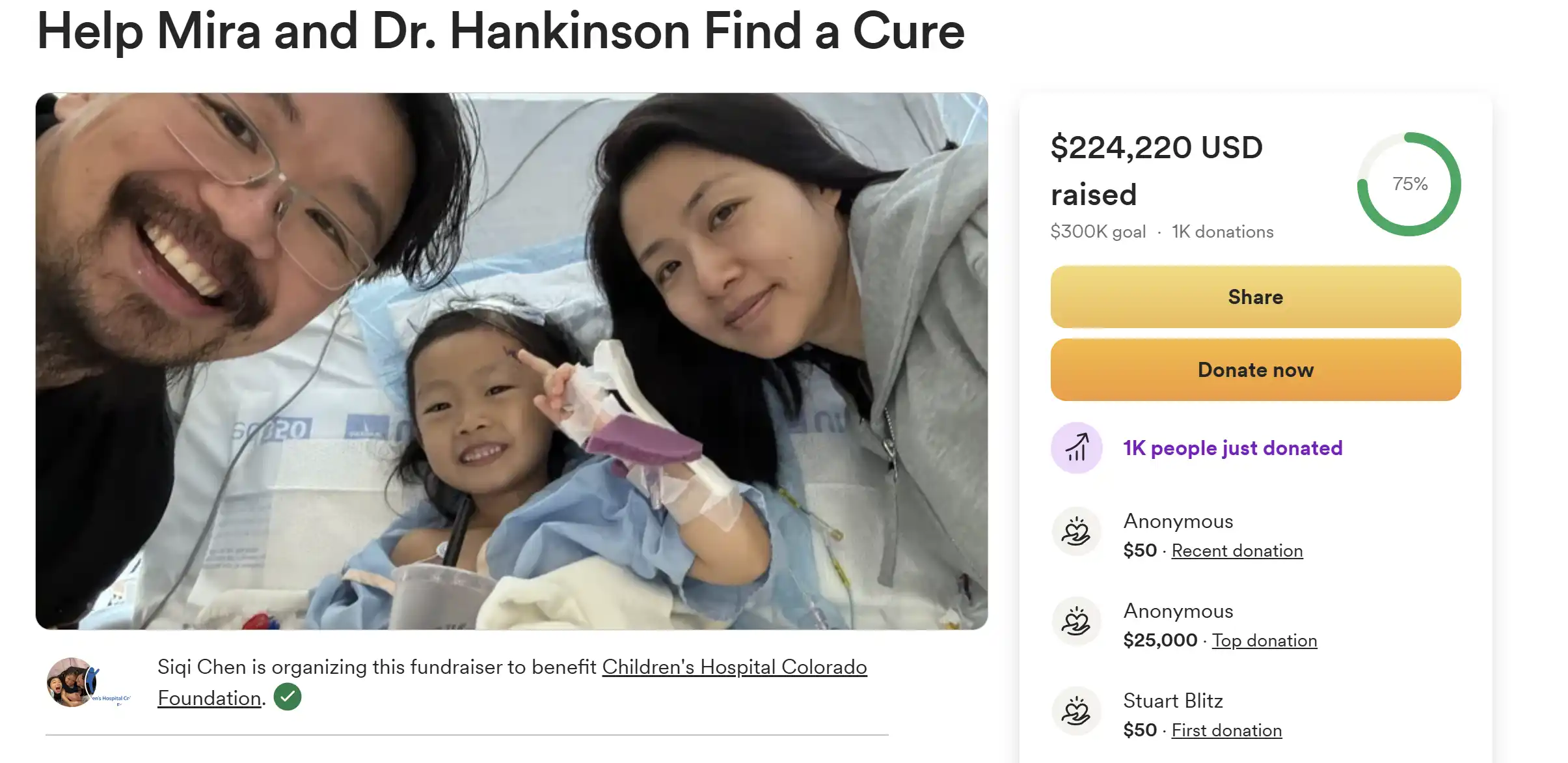
Web3 Crowdfunding Resurgence
However, what seems to be a story of a friend circle crowdfunding renaissance on Twitter has only just begun. In addition to fundraising through Web2, Chen Siqi did not forget to include his Solana and BTC addresses.
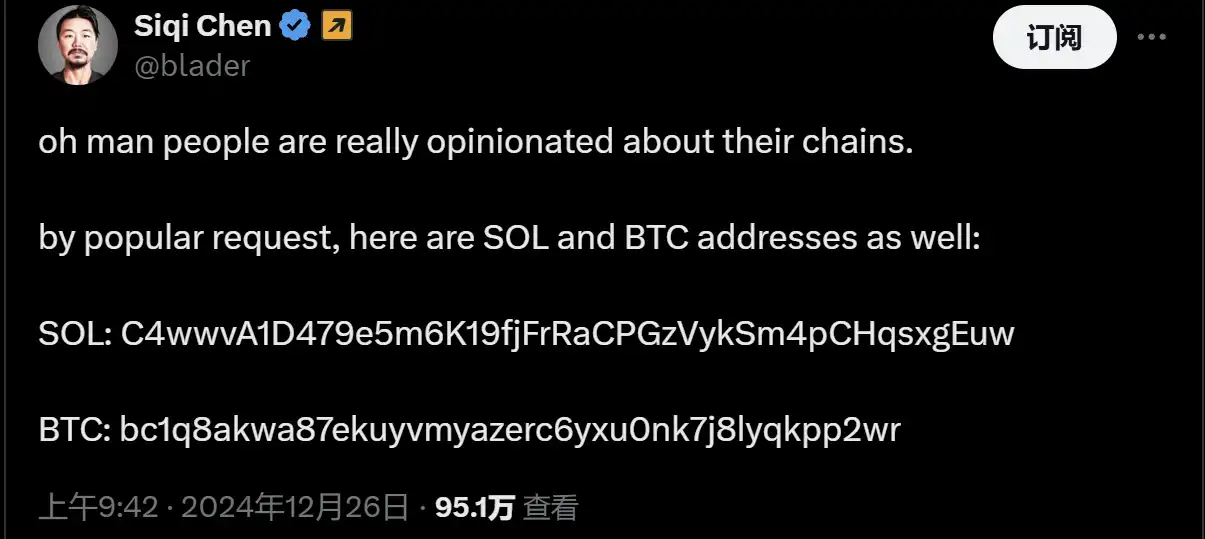
Mira's story was able to break into the crypto scene, thanks to the efforts of two men.
One of them is Shaw, who is still preaching in China. After learning about Mira's situation, Shaw donated $100,000 worth of $degenai tokens to Chen Siqi's wallet to help their family through tough times. The other is Dev from pump.fun who created the token Waddles. After witnessing Mira's story, Waddles donated 50% of the $MIRA tokens to this father who was running around to treat his daughter's illness. Where there is attention, there is funding flow. With the support of Shaw, Ronak, and other Web3 and Web2 personalities, MIRA experienced a nearly 60x price increase in less than 3 hours.
So, who is Chen Siqi, and why did Shaw pay attention to her? Chen Siqi is the founder and CEO of Runway, a startup backed by a16z. Chen Siqi also served as the CEO of SandVR (a16z) and the Chief Product Officer of Postmates (later acquired by Uber). It is because of his professional background that he received such widespread support from the "big shots."
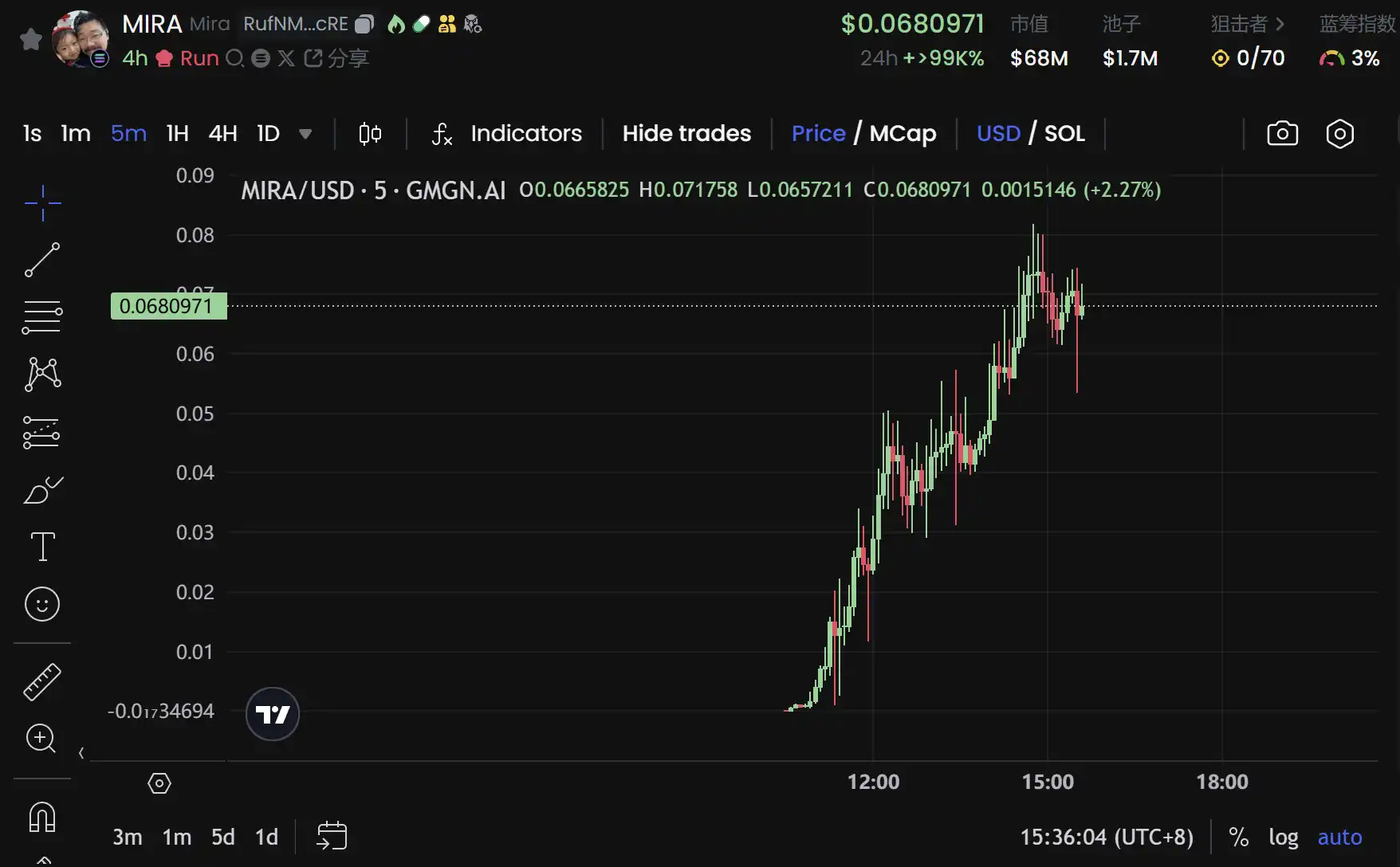
At the same time, Bio Protocol also took note of this scientific donation event and believes that decentralized scientific funding will become a major use case for crypto in the next cycle. Rare disease research is rarely funded in real life, and the pump.fun and MIRA incident have further pushed the Desci narrative to a climax.

Through the interaction between Bio Protocol and Shaw, MIRA has become the iconic Meme of the Desci concept.
Dad Chen Walking on a Tightrope: How Should the Donation Be Handled?
Despite having a large amount of funding, how to handle this donation is also a question. Obviously, Chen Siqi is also at a loss. If this funding is managed well, not only can it raise funds for his daughter, but it can also further broaden the development direction of Desci. If mishandled, it will not only cause public outrage but may also be similar to the judge's question, "If it wasn't you who touched it, why did you help?"—people will not foot the bill for similar cases again.
Therefore, Chen Siqi handled the situation very cautiously. As early as 4 hours ago, Chen Siqi announced his intention to sell 10% of the supply at some point today to donate to the Hansen Lab, with the remaining portion being reserved, accounting for 5% of the total supply. Unless announced at least 24 hours in advance, he will not sell any more tokens. Furthermore, in terms of fund management, Chen Siqi has started soliciting the opinions of netizens on Twitter regarding selling a portion of his own position, while also announcing that any newly injected funds will be entirely donated to the Hansen Lab for cancer research.
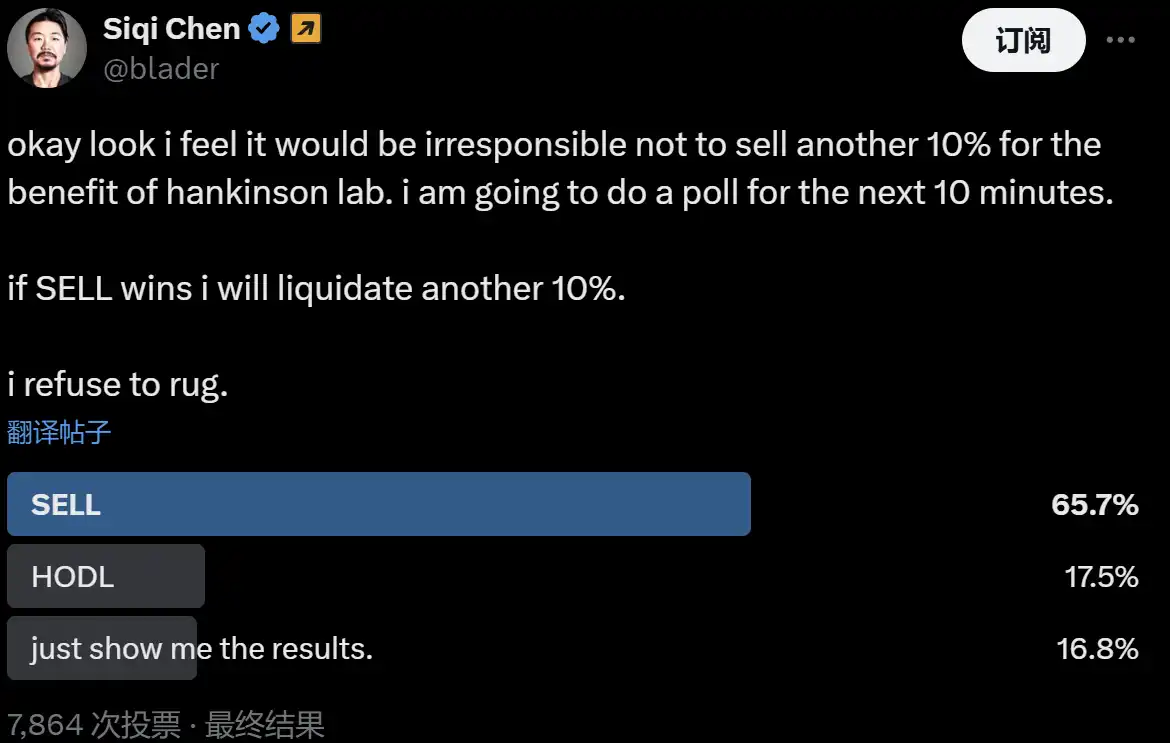
Although Chen Siqi's and Mira's stories received mixed reviews on Twitter, blockchain has proven the feasibility of on-chain donations and fundraising through its transparency and widespread participation. The flow of each fund can be guaranteed under public scrutiny. Perhaps on-chain donations will be a dawn before the large-scale application of Web3.
You may also like

Bitcoin Trading Guide 2026: Strategies for Experienced Traders

What Is XAUT and PAXG? Why Tokenized Gold Is Booming in 2026

Cryptocurrency CEXs are flocking to sell US stocks, and traditional brokerages are facing an "uninvited guest."

Will the SpaceX IPO Hurt Bitcoin? Here's What Traders Are Watching
Foreign selling in the South Korean stock market accelerates, with cumulative net sales reportedly reaching $75 billion this year
On June 9, The Kobeissi Letter, citing Goldman Sachs data, reported that global investors are selling South Korean stocks at an unusually rapid pace. In the latest trading session, foreign investors sold about $801 million worth of Kospi constituent stocks again; total foreign outflows last week reached about $10 billion, and the market has been in net foreign selling on nearly every trading day over the past month. According to the data cited in the report, foreign investors have sold about $75 billion worth of South Korean stocks so far this year. Meanwhile, South Korean retail and institutional investors together recorded roughly $69 billion in net buying over the same period, suggesting that the market’s main buying support has come from domestic capital rather than returning overseas funds. The information currently disclosed still mainly comes from The Kobeissi Letter’s retelling and Goldman Sachs data summaries, while public details on the statistical period and the specific definition of “selling” remain relatively limited.

Fortune Warns of Strategy’s Financing Structure Risks as Bitcoin Premium Narrows
Fortune warned that Strategy’s Bitcoin treasury model faces growing financing risks as MSTR’s net asset premium narrows and preferred stock dividend pressure increases.

Ferrari Challenge Le Mans: Carl Moon to Dominate in WEEX Livery

Sahara AI Responds to SAHARA’s Sharp Drop: No Contract or Product Security Issues Found, Internal Investigation Underway
Sahara AI responded to SAHARA’s 60% price drop, saying no token contract or product security issues have been found and an internal investigation is underway.

WEEX Deposit/Withdrawal Dynamic Island: Your Asset Status, Always in Sight

Scaling Crypto Derivatives: The Digital Asset Infrastructure Behind High-Volume Trading
In the fast-moving digital asset ecosystem, derivatives platforms face an extreme architectural test. High-leverage futures markets demand more than just standard security—they require absolute operational precision, zero-latency matching engines, and ironclad structural scalability, all while navigating intense market volatility.
As global platforms scale to meet these demands, the industry is shifting away from rigid, monolithic setups toward a more agile, "decoupled" infrastructure philosophy.
The Blueprint for High-Volume Copy TradingFor elite global exchanges like WEEX (founded in 2018), this architectural choice becomes critical when scaling high-volume retail features like social copy trading. When thousands of users automatically mirror the real-time strategies of elite traders simultaneously, it triggers sudden, monumental spikes in concurrent transactional volume.
To prevent execution latency or settlement bottlenecks during these peak volatility events, a platform's primary engine must remain entirely dedicated to risk management, copy-trade synchronization, and order matching.
The Architectural Rule: New-generation platforms must separate front-end user execution engines from heavy backend infrastructural overhead to eliminate operational friction.
By separating these layers, platforms can maintain complete sovereignty over their trading environments and user experiences while strategically aligning with institutional-grade infrastructure ecosystems. This strategic framework allows modern exchanges to leverage advanced Digital Asset Custody infrastructure such as Cobo’s behind the scenes, ensuring that backend wallet management scales elastically alongside trading spikes.
Capitalizing on Market Momentum and 400× LeverageIn a derivatives arena where platforms offer up to 400× leverage on perpetual contracts, capital efficiency and market agility are core business metrics. To capture market momentum, an exchange needs the ability to rapidly expand its asset offerings, supporting everything from legacy crypto assets to sudden, trending altcoins across a massive library of trading pairs.
Adopting a flexible, scalable Wallet-as-a-Service (WaaS) solution such as Cobo’s could completely rewrite the development timeline for high-growth exchanges. Instead of spending months of engineering capital building out custom backend wallet architectures for every new blockchain network, platforms can deploy localized infrastructure in days.
This agility allows platforms to instantly scale their listings to over a thousand trading pairs without compromising security or delaying time-to-market. It mirrors the exact operational advantages seen during high-velocity market events, similar to how advanced wallet infrastructure empowers platforms during sudden asset surges; allowing exchanges to pass that speed and liquidity directly to their global user base.
A Mature Foundation for GrowthThe synergy between trusted infrastructure ecosystems and global trading platforms represents the natural evolution of a maturing crypto market. As WEEX continues to scale its global spot and derivatives offerings for over 6 million users, adopting robust backend paradigms proves that platforms no longer have to compromise between cutting-edge trading velocity and uncompromised structural security.

Morning Report | BitMine increased its holdings by 126,971 ETH last week; trader Eugene announced his exit from the crypto market

Wang Chuan: How can one not feel anxious after the neighbor Old Wang made thirty times profit by investing in storage stocks? (Seven) - A quarter-century cycle

Get Paid to Onboard? Try WEEX’s New Homepage with Rewards for Registration, Deposit & Trade

WEEX Custom Layout: Build Your Perfect Trading Workspace in Seconds

See “Buy Walls” & “Sell Walls” Instantly: WEEX Launches the Depth Chart for Smarter Trades

What Is Quick Trade on WEEX? 2 Ways WEEX Ends Chart-Panel Jumping
Morning News | Five major virtual asset platforms in South Korea have experienced 57 incidents of hacking and system failures in six years; Grayscale submits registration application for Canton ETF
Should we escape the peak? The principle of the tail-end market in the stock market
Bitcoin Trading Guide 2026: Strategies for Experienced Traders
What Is XAUT and PAXG? Why Tokenized Gold Is Booming in 2026
Cryptocurrency CEXs are flocking to sell US stocks, and traditional brokerages are facing an "uninvited guest."
Will the SpaceX IPO Hurt Bitcoin? Here's What Traders Are Watching
Foreign selling in the South Korean stock market accelerates, with cumulative net sales reportedly reaching $75 billion this year
On June 9, The Kobeissi Letter, citing Goldman Sachs data, reported that global investors are selling South Korean stocks at an unusually rapid pace. In the latest trading session, foreign investors sold about $801 million worth of Kospi constituent stocks again; total foreign outflows last week reached about $10 billion, and the market has been in net foreign selling on nearly every trading day over the past month. According to the data cited in the report, foreign investors have sold about $75 billion worth of South Korean stocks so far this year. Meanwhile, South Korean retail and institutional investors together recorded roughly $69 billion in net buying over the same period, suggesting that the market’s main buying support has come from domestic capital rather than returning overseas funds. The information currently disclosed still mainly comes from The Kobeissi Letter’s retelling and Goldman Sachs data summaries, while public details on the statistical period and the specific definition of “selling” remain relatively limited.
Fortune Warns of Strategy’s Financing Structure Risks as Bitcoin Premium Narrows
Fortune warned that Strategy’s Bitcoin treasury model faces growing financing risks as MSTR’s net asset premium narrows and preferred stock dividend pressure increases.


