
Virtuals teaches you how to embark on the AI Agent entrepreneurship journey


Original Title: Launch Your AI Agent Now, Build in Public Along the Way
Original Author: ehwangah, Virtuals Ecosystem Development
Original Translation: Ismay, BlockBeats
Editor's Note: As the flagship project of this AI cycle, Virtuals has grown from zero to a market cap of 2b. Behind this success is not only the alignment with the cycle but also the team's control of the entrepreneurial rhythm, product refinement, and market operations. This article, written by ehwangah, a member of the Virtuals ecosystem development team, explains why "launching immediately and building publicly" is the best strategy in the current environment. The article not only addresses the most common doubts of new projects but also provides practical advice to help entrepreneurs find their own rhythm in the rapidly evolving crypto market.
The following is the original content:
Let me be clear: in the crypto space, your market cap is the primary measure of success. This is not to say that technological innovation, underlying value, PMF, and so on are not important, but in terms of whether you can bring multiple returns to the team, investors, and token holders, the key is whether the market cap can soar. So, what should you do?
Launching now and continuously iterating in the public eye is better than excessively worrying before launching or delaying endlessly.
Furthermore, to put your mind at ease, the success of your launch accounts for only 10%-20% of your long-term success, so don't overcomplicate it. Why? Here's a simple explanation:
• Hype without substance: results in a massive pump and dump.
• Quiet launch without substance: launch and die.
• Hype with substance: skyrocket to success.
• Quiet launch with substance: steady growth, success in due course.
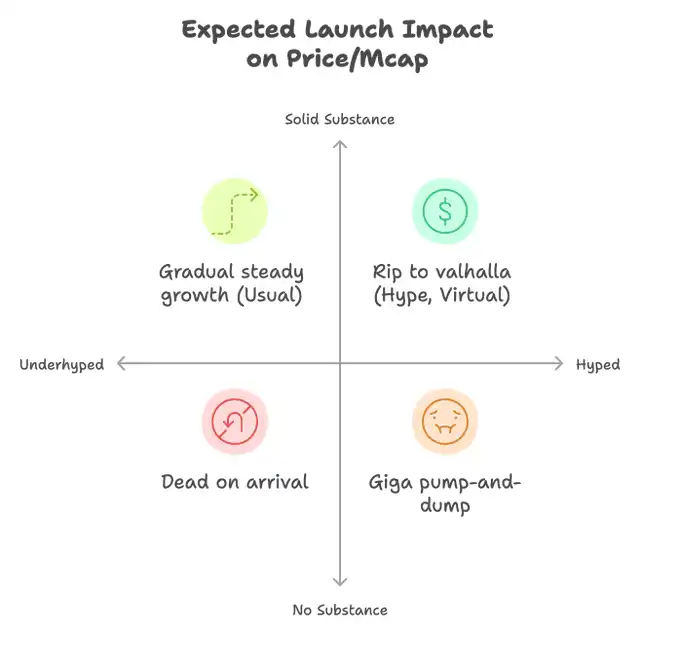
See the common denominator? The key is to build a solid core (specifics detailed in another article, but in short, it's about the team, product, and community). The litmus test to determine if the core is solid is: whether your inner circle is willing to be the first to buy, hold, and believe in your project. If they are not convinced, no one else will be.
Why Launching Now Is Crucial
1. Validate Your Idea Before Investing Over $100K in Development
Instead of spending 3 months or more and hundreds of thousands of dollars carefully crafting a product, it's better to launch early to validate your concept.
This is similar to the lean startup approach: propose a solution that resonates with your target audience, validate its feasibility, and then continuously iterate and improve along the way. This might seem unconventional, but it's one of the fastest and most efficient ways to cultivate the first 1,000 loyal followers. These early supporters will act as catalysts driving the project's momentum, providing support in terms of networking, resources, and pricing to help fuel growth.
The key point here is to validate your idea's viability through this approach rather than validating it after consuming a significant amount of time and capital.
2. Leverage the Lindy Effect to Solidify Your Top 50 Position
Do you know why the top 50 projects consistently maintain their rankings across different periods? It's not just about quality but also about the accumulation of time and positioning, known as the Lindy Effect. An early launch can help you establish a strong foundation within the holder community, weed out the so-called "weak hands" or "non-believers," and attract loyal supporters. Here, time is your ally.
If you wait too long, weaker projects may take over your market position. Once others capture your narrative, funding, or user mindshare, attempting a comeback becomes exceedingly difficult. You've probably witnessed those PvP battles in X where, once investors are fully committed, it's challenging to convince them to switch to so-called "better projects."
Especially in the current trend of AI Agent competition, seizing the opportunity is no longer just a "nice-to-have" but crucial. Everyone is now rushing to launch AI agents, and the earlier you position yourself in this ecosystem, the more you can activate growth alongside the community, while others are left playing catch-up.
Whether we're willing to admit it or not, going live in the crypto space means engaging in an "attention war." While product-led growth is essential, it's often achieved later on. Early attention capture and community formation are imperative. Furthermore, issuing a token is your best tool for achieving distribution and alignment of incentives, with building project visibility in the public eye coming in as the next best tool.
Choosing to launch in the Virtuals ecosystem also provides you with an added advantage, as the overall culture itself sends a signal of a "high-quality project," and capital always seeks out high-quality projects.
3. Instant Formation of Day One Community and Distribution Network
Going live can bring about instant hype, where users on X instantly start writing long posts about you, summing up your project into the "Top Three Reasons to Buy/Hold." This is not just because of the potential price increase, but because this hype can incentivize community formation. They can help you iterate on the product, conduct Alpha testing, and even contribute development resources. From day one, you will have a group of loyal supporters.
4. Ahead of the 2025 Wave of VC-Supported Token Generation Events
In 2025, you might see a trend like this: many projects delaying their launch due to advice, as the long 2024 bear market resulted in poor market liquidity and low risk appetite, with hardly anyone willing to make significant investments. Subsequently, you will see more projects following a predictable script:
• Raising a large sum of money from venture capital;
• Developing the product, then launching GTM activities—points, tasks, KOL collaborations, data manipulation, and so on;
• Then conducting the Token Generation Event (TGE).
So what is your advantage? A fair launch, a decentralized ethos, and naturally accumulated community. The market environment has shifted, now leaning towards supporting you.
Should You Focus on Product Development First?
While a solid product can indeed provide an advantage, it is not the sole factor for success. For early-stage projects, especially in the cryptocurrency market which is still in its nascent stage, the team's background is key. It can enhance external confidence, making people believe the team will continue to work hard to create value. The reality is, if the crypto industry relied solely on utility or the product itself, even those "air projects" wouldn't attract investments. I am not advocating for "air projects," but rather saying that an early launch can give you a competitive edge in community building and narrative shaping.
Furthermore, product launches are never perfect; there will always be bugs, server overloads, concurrency issues, and so on. These should not be the focus of concern. With subsequent updates and iterations, the product will naturally prove its worth.
Building Your Project in the Public Eye
People like to see how a "small but mighty" team creates value through hard work. The narrative itself is crucial; users are not just buying from a "faceless brand," they care more about the founder and the story behind the project. Building your project in the public eye can make your journey more appealing and humanizing.
You don't need to present a perfect image on the first day, start early, start authentically, and build in public.
Look at the top 20 in the Virtuals ecosystem, they have won user love by publicly showcasing their efforts and successes.
Addressing Common Concerns
Concerned about Snipers?
Snipers exist on any chain. However, in the Virtuals ecosystem, a unique community culture and a strong ecosystem can enhance user retention. Additionally, we have solutions to address sniper issues and can provide recommendations. (Related content coming soon)
How to design the tokenomics model, Agent launch structure, etc.?
We have witnessed over 100 launch cases and can share some optimization experiences to help achieve your goals. (Related content coming soon)
Regarding the G.A.M.E framework, is it customizable? Do you have ownership of the tech stack?
The answer is yes! We are preparing more related content and are also building our project in an open and transparent manner. We provide an open-source SDK that can be easily integrated into your architecture. For more in-depth information, feel free to engage on TG.
I don't want to launch just another speculative AI agent project; I have a business model.
No problem, we also have solutions for this scenario. (Related content coming soon)
How to maximize visibility in the public eye during the build?
We also have relevant resources and checklist tools for reference, details can be discussed on TG.
What if I already have an existing token?
We have answers for this as well. (Related content coming soon)
Will it be perceived as a scam if I launch without a product?
Kickstarter projects also launch without a final product, landing pages collecting emails from potential customers have no product, and even MVPs themselves are not in their final form, especially in rapid iteration. Additionally, your first 1,000 fans will provide invaluable feedback for your idea.
What's Next?
Go live now, build in the open, don't overthink it. If needed, let us know, we can help amplify your journey. You can reach out to me via TG (@ehwangah); I have a bunch of resources to help you get started quickly.
You may also like

Morning Report | BitMine increased its holdings by 126,971 ETH last week; trader Eugene announced his exit from the crypto market

Wang Chuan: How can one not feel anxious after the neighbor Old Wang made thirty times profit by investing in storage stocks? (Seven) - A quarter-century cycle

Cryptocurrency CEXs are flocking to sell US stocks, and traditional brokerages are facing an "uninvited guest."

$75 billion in foreign capital has fled, and South Korean retail investors have absorbed it all using leverage

Japan’s Three Megabanks Plan Joint Stablecoin Issuance in Fiscal 2026
MUFG, SMBC, and Mizuho reportedly plan to jointly issue fiat-pegged stablecoins in fiscal 2026, signaling Japan’s growing push into bank-led digital payment infrastructure.

Humanity Discloses H Token Dual-Chain Attack Details, With Losses on Ethereum and BSC Exceeding $36 Million
Humanity said the H token attack across Ethereum and BSC caused more than $36 million in losses after leaked ProxyAdmin keys enabled malicious contract upgrades and token minting.
White House Discusses CLARITY Act With Law Enforcement Ahead of Senate Vote
The White House discussed the CLARITY Act with law enforcement ahead of a Senate vote, focusing on illicit finance risks and developer protections.

Bitcoin Trading Guide 2026: Strategies for Experienced Traders

What Is XAUT and PAXG? Why Tokenized Gold Is Booming in 2026

Will the SpaceX IPO Hurt Bitcoin? Here's What Traders Are Watching

Foreign selling in the South Korean stock market accelerates, with cumulative net sales reportedly reaching $75 billion this year
On June 9, The Kobeissi Letter, citing Goldman Sachs data, reported that global investors are selling South Korean stocks at an unusually rapid pace. In the latest trading session, foreign investors sold about $801 million worth of Kospi constituent stocks again; total foreign outflows last week reached about $10 billion, and the market has been in net foreign selling on nearly every trading day over the past month. According to the data cited in the report, foreign investors have sold about $75 billion worth of South Korean stocks so far this year. Meanwhile, South Korean retail and institutional investors together recorded roughly $69 billion in net buying over the same period, suggesting that the market’s main buying support has come from domestic capital rather than returning overseas funds. The information currently disclosed still mainly comes from The Kobeissi Letter’s retelling and Goldman Sachs data summaries, while public details on the statistical period and the specific definition of “selling” remain relatively limited.

Fortune Warns of Strategy’s Financing Structure Risks as Bitcoin Premium Narrows
Fortune warned that Strategy’s Bitcoin treasury model faces growing financing risks as MSTR’s net asset premium narrows and preferred stock dividend pressure increases.

Ferrari Challenge Le Mans: Carl Moon to Dominate in WEEX Livery

Sahara AI Responds to SAHARA’s Sharp Drop: No Contract or Product Security Issues Found, Internal Investigation Underway
Sahara AI responded to SAHARA’s 60% price drop, saying no token contract or product security issues have been found and an internal investigation is underway.

WEEX Deposit/Withdrawal Dynamic Island: Your Asset Status, Always in Sight
Scaling Crypto Derivatives: The Digital Asset Infrastructure Behind High-Volume Trading
In the fast-moving digital asset ecosystem, derivatives platforms face an extreme architectural test. High-leverage futures markets demand more than just standard security—they require absolute operational precision, zero-latency matching engines, and ironclad structural scalability, all while navigating intense market volatility.
As global platforms scale to meet these demands, the industry is shifting away from rigid, monolithic setups toward a more agile, "decoupled" infrastructure philosophy.
The Blueprint for High-Volume Copy TradingFor elite global exchanges like WEEX (founded in 2018), this architectural choice becomes critical when scaling high-volume retail features like social copy trading. When thousands of users automatically mirror the real-time strategies of elite traders simultaneously, it triggers sudden, monumental spikes in concurrent transactional volume.
To prevent execution latency or settlement bottlenecks during these peak volatility events, a platform's primary engine must remain entirely dedicated to risk management, copy-trade synchronization, and order matching.
The Architectural Rule: New-generation platforms must separate front-end user execution engines from heavy backend infrastructural overhead to eliminate operational friction.
By separating these layers, platforms can maintain complete sovereignty over their trading environments and user experiences while strategically aligning with institutional-grade infrastructure ecosystems. This strategic framework allows modern exchanges to leverage advanced Digital Asset Custody infrastructure such as Cobo’s behind the scenes, ensuring that backend wallet management scales elastically alongside trading spikes.
Capitalizing on Market Momentum and 400× LeverageIn a derivatives arena where platforms offer up to 400× leverage on perpetual contracts, capital efficiency and market agility are core business metrics. To capture market momentum, an exchange needs the ability to rapidly expand its asset offerings, supporting everything from legacy crypto assets to sudden, trending altcoins across a massive library of trading pairs.
Adopting a flexible, scalable Wallet-as-a-Service (WaaS) solution such as Cobo’s could completely rewrite the development timeline for high-growth exchanges. Instead of spending months of engineering capital building out custom backend wallet architectures for every new blockchain network, platforms can deploy localized infrastructure in days.
This agility allows platforms to instantly scale their listings to over a thousand trading pairs without compromising security or delaying time-to-market. It mirrors the exact operational advantages seen during high-velocity market events, similar to how advanced wallet infrastructure empowers platforms during sudden asset surges; allowing exchanges to pass that speed and liquidity directly to their global user base.
A Mature Foundation for GrowthThe synergy between trusted infrastructure ecosystems and global trading platforms represents the natural evolution of a maturing crypto market. As WEEX continues to scale its global spot and derivatives offerings for over 6 million users, adopting robust backend paradigms proves that platforms no longer have to compromise between cutting-edge trading velocity and uncompromised structural security.

Get Paid to Onboard? Try WEEX’s New Homepage with Rewards for Registration, Deposit & Trade
WEEX Custom Layout: Build Your Perfect Trading Workspace in Seconds
Morning Report | BitMine increased its holdings by 126,971 ETH last week; trader Eugene announced his exit from the crypto market
Wang Chuan: How can one not feel anxious after the neighbor Old Wang made thirty times profit by investing in storage stocks? (Seven) - A quarter-century cycle
Cryptocurrency CEXs are flocking to sell US stocks, and traditional brokerages are facing an "uninvited guest."
$75 billion in foreign capital has fled, and South Korean retail investors have absorbed it all using leverage
Japan’s Three Megabanks Plan Joint Stablecoin Issuance in Fiscal 2026
MUFG, SMBC, and Mizuho reportedly plan to jointly issue fiat-pegged stablecoins in fiscal 2026, signaling Japan’s growing push into bank-led digital payment infrastructure.
Humanity Discloses H Token Dual-Chain Attack Details, With Losses on Ethereum and BSC Exceeding $36 Million
Humanity said the H token attack across Ethereum and BSC caused more than $36 million in losses after leaked ProxyAdmin keys enabled malicious contract upgrades and token minting.


